Circular Saws: The Complete Buying Guide
Choose a circular saw that handles your material thickness and cut angle: a standard saw for varied lumber cuts, a compact saw for smaller jobs, or a track saw for guided panel cuts. Pick corded or cordless power around your workspace and existing batteries.
On this page (11 sections)
- What type of circular saw fits your work?
- How do blade size and cut depth affect your choice?
- Should you choose a corded or cordless circular saw?
- Which saw features help with control and visibility?
- Do you need a guide rail or track saw?
- What should beginners check before buying?
- How should you set up before the first cut?
- Which common mistakes spoil circular saw cuts?
- How do you care for a circular saw?
- How do you compare circular saws for your projects?
- Which circular saw should you choose?
Choose a circular saw by material thickness, cut angle and workspace. A standard model suits varied lumber and sheet cuts, a compact model suits smaller work, and a track saw suits guided panel cuts where the finished edge matters.
Start with the cuts you actually need, then choose the power source and controls that support them. Blade size, battery voltage and motor speed are useful details, but none replaces checking cut capacity.
For a quick overview of specific models, start with our best circular saws roundup. This guide explains which type to choose, where each example fits and how to build a useful setup around it.
What type of circular saw fits your work?
Choose a standard circular saw for varied building tasks, a compact model for smaller cuts, or a track saw for repeated guided panel work. Corded and cordless describe the power source, so make that choice separately from the saw's size and cutting system.
| Saw type | Choose it for | Main trade-off |
|---|---|---|
| Standard circular saw | Lumber, sheet goods and varied project cuts | Long finished cuts need careful guidance |
| Compact circular saw | Smaller pieces and work within its cut capacity | Less depth can limit thicker or angled cuts |
| Track saw | Guided panel cuts and suitable plunge work | Track setup needs room and compatible equipment |
| Corded power | A regular cutting area near an outlet | The cord must stay clear throughout the cut |
| Cordless power | Work spread across a house or worksite | Batteries and charging become part of the setup |
For shelves, rough framing and occasional plywood cuts, a standard saw is a sensible starting point. You can add a suitable straightedge when a cut needs more control.
Choose a compact saw because its capacity and shape fit your jobs. A smaller blade does not automatically mean lower weight, a better grip or enough depth for every board.
A track saw earns its place when you repeatedly cut panels to accurate sizes or need clean edges for assembly. It takes more preparation than a short lumber crosscut, but the guided path becomes useful across a long sheet.
Think about the work area as well as the tool. A saw that fits in a small cabinet still needs enough space to support the material and complete the cut safely.
Learn the power-source differences in our guides to corded circular saws and cordless circular saws. If you're weighing a guided setup, see circular saw vs track saw.
How do blade size and cut depth affect your choice?
Buy a saw with enough actual cut depth at your working angle. Blade diameter helps narrow the field, but the saw's design and bevel setting determine how much material it can cut.
Check the thickest piece in your project rather than its name alone. Nominal lumber sizes describe a size category, so measure the material when capacity is close.
Beveling reduces available depth because the blade passes through the board at an angle. A saw that clears a board squarely may leave an uncut strip when tilted.
Plan for the finished cut, too. If you're shortening rough lumber, speed may matter most; if you're cutting a visible shelf edge, blade choice and steady guidance deserve more attention.
For wood, fewer teeth generally suit faster rough cuts, while more teeth often suit cleaner edges. Tooth shape, blade condition and suitability for the material also affect the result.
Use only a blade size, arbor fit and speed rating approved for the saw. A blade that fits over the arbor is not enough evidence that it belongs on that tool.
Circular saw blade sizes in these examples
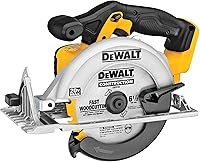
The DeWalt DCS391B is the standard cordless example here, with a 6-1/2 in blade, magnesium shoe and bevel adjustment from 0 to 50 degrees. It includes a carbide-tipped blade.
Choose it for varied wood projects when you want cordless movement without choosing a compact cutting format. Its rubber overmolded grip is another feature to assess when comparing handling.
Skip it if your main task is repeated guided panel cutting or if its verified depth does not cover your planned bevel cuts. Check that capacity before committing to thicker material.
The DeWalt DCS571B uses a 4-1/2 in blade and a bevel gear design that allows square cuts through 2x material. At 45 degrees, its stated application is 1x dimensional lumber.
That makes it a useful candidate for smaller wood projects that stay within those limits. It is a poor match if you expect its square-cut capacity to remain available when beveling.
Don't plan routine work around flipping a thick board to finish a cut from the opposite side. Matching the cuts adds alignment work, so choose adequate single-pass capacity when that thickness is a regular need.
For blade fit and orientation, read which way a circular saw blade goes and how to change a circular saw blade.
Should you choose a corded or cordless circular saw?
Choose cordless for movement between work areas, or corded for a regular cutting station with suitable power nearby. Existing batteries can make cordless convenient, but they should not push you toward a saw with the wrong capacity.
A corded setup suits repeated cuts at a bench or supported work area. You avoid charging pauses, but you still need to route the cord so it cannot catch the work, guide or saw.
For an extension cord, follow the saw manual's requirements for cord length and wire size. Don't choose a long, thin cord simply because its plug fits.
Cordless suits work where moving a power cord would slow each change of position. Plan where charged batteries will come from and where you can charge them under the charger's stated conditions.
The DCS391B is a 20V MAX tool with its battery and charger sold separately. The DCS571B is also tool-only and works with DeWalt 20V MAX batteries and chargers.
Count all the equipment you need when comparing setups. A bare tool may fit an existing battery collection, while a first cordless saw requires a complete power plan.
The Skil 5280-01 suits a buyer who wants a standard corded saw for lumber and sheet goods near an outlet. It has a 15-amp motor, an included 7-1/4 in carbide-tipped blade and a carry bag.
Its bevel range reaches 51 degrees, with a positive stop at 45 degrees. That stop helps you return to a common setting, though finish work still calls for checking the angle.
Choose the Skil for a fixed work area where cord management is straightforward. Skip it if your projects regularly move beyond practical outlet reach or you specifically need a dedicated track system.
For battery-powered options, compare our best cordless circular saws and see how to choose a cordless circular saw. If you prefer a cord, our best corded circular saws roundup can narrow the options.
Which saw features help with control and visibility?
Prioritize a stable shoe, usable grips and a clear cutting path. Extra features help only when they solve a problem you face during the cut.
The shoe supports the saw on the workpiece and provides an edge for following a guide. Before buying, consider how much of that base will rest on your usual pieces.
Weight matters in context. A heavier saw may feel manageable on a supported sheet, while the same tool may be awkward to position repeatedly on narrow boards.
Compare weight with the equipment you'll use. A cordless tool's handling can change with its battery, and a dust hose or power cord can pull against your movement.
The Skil has a single-beam laser and a dust blower to help keep the cut line visible. A laser shows a reference line; it does not physically hold the saw on course.
The DCS571B has a removable auxiliary handle, on-board dust port and electronic blade brake. Its included dust port adapter is useful to consider when planning a compatible extraction connection.
A blower moves dust away from the line, while extraction aims to collect it. Neither replaces eye protection, suitable dust protection or keeping the workspace clear.
DeWalt says the DCS571B's brake stops the blade quickly. Wait for a complete stop before setting the saw down, even when a brake is fitted.
Keep both hands in the positions directed by the manual. Never reach beneath the workpiece to hold it or clear chips while the saw is powered.
Do you need a guide rail or track saw?
Use a suitable straightedge for occasional guided cuts, or choose a track saw when guided panel work is a regular part of your projects. A standard saw guide and a dedicated track system solve the same broad problem in different ways.
With a straightedge, the shoe follows the guide while the blade cuts a set distance away. Measure that offset for the shoe edge you're using, and make a practice cut on scrap before sizing a finished piece.
A track saw runs on a compatible rail designed for that saw. The cutting system helps you place and guide the cut without measuring a separate shoe offset each time.
The DeWalt DWS520K is a corded track saw that works with DeWalt's dual-edged tracks for guided cuts in either direction. Its on-track depth is 2-1/8 in at 90 degrees and 1-5/8 in at 45 degrees.
It includes the saw, a 48-tooth blade, blade wrench and kit box. Budget for a compatible track unless your chosen package expressly includes one.
Choose it for regular panel sizing, shelf parts and other work where a guided edge helps the next assembly step. Skip it as your first choice for mostly short, rough lumber cuts that don't benefit from a rail.
DeWalt describes the zero-clearance track system as producing splinter-free cuts. For a visible edge, still use a suitable sharp blade, support the panel and check the result on matching scrap.
The saw has a riving knife and continuous anti-kickback mechanism for use as directed. These features support the cutting system but do not make poor support or a binding cut acceptable.
Our DIY track saw guide explains how a guide can help, while is a track saw worth it? covers dedicated setups. Compare circular saw guides and guide rails for standard saws.
What should beginners check before buying?
Beginners should choose adequate capacity and controls they can use comfortably. A saw becomes easier to learn when you can set its depth, lock its bevel and hold its grips without struggling.
With power disconnected, check whether you can reach the adjustments and read their markings. Make sure the shoe and bevel locks feel secure when set according to the manual.
Look at how the saw will begin and end your usual cuts. You need a stable starting position, a clear blade path and room to finish without stretching across the work.
The Skil's safety lock and guarded trigger address starting controls. The DCS571B's auxiliary handle provides another grip option, while the DCS391B has a rubber overmolded grip.
Choose among those features based on how you will hold and position the tool. No single control makes a saw the right choice for every new user.
Also decide where you will cut before buying. A flat support surface, clamps and clear floor space contribute more to a useful first setup than a feature you'll rarely use.
Our best circular saws for beginners roundup focuses on options for new users. For a step-by-step overview, read how to use a circular saw.
How should you set up before the first cut?
Set up the material, blade and cutting path before connecting power. Good support keeps the work steady and reduces the chance of the closing cut pinching the blade.
Read the manual for your exact saw, including its guard, depth adjustment and starting procedure. Wear eye and hearing protection, and use suitable dust protection for the material.
Support the piece and plan the offcut
Clamp the work so it cannot slide or twist during the cut. Position supports so the cut stays open and neither the blade nor the falling offcut can strike a support.
For large panels, a suitable sacrificial support surface can hold both sides of the cut. For boards, plan where the offcut will go without placing a hand in its path.
Check below the cut for screws, clamps, bench parts and other objects. Also inspect the material for embedded fasteners before choosing a cutting line.
Set depth and bevel with power disconnected
Set only the blade exposure needed for the material, following the manual's guidance. Excessive exposure puts more blade below the work than the cut requires.
Lock the depth and bevel adjustments before starting. If the angle affects how parts fit together, verify it on scrap rather than relying only on the scale.
When changing between square and bevel cuts, check the guide position again. The appropriate shoe mark or blade relationship can change with the angle.
Check the whole travel path
Place the saw at the start with the blade clear of the work. Confirm that the shoe has support and that your stance lets you complete the cut without overreaching.
For guided work, move the disconnected saw through the planned path to check clamp clearance. Leave enough room for the motor housing, guard, battery, cord and dust hose.
Start the saw as directed and let it reach operating speed before entering the material. Feed steadily without forcing it, keeping the shoe flat and your hands clear.
For longer cuts, our guide to cutting straight with a circular saw explains guide placement and line control.
Which common mistakes spoil circular saw cuts?
The most common avoidable problems are poor support, the wrong blade and a rushed setup. Fix those before blaming motor power or buying another saw.
Measuring to the wrong side of the blade
The blade removes a strip of material called the kerf. Put that strip on the waste side of your line when the marked dimension needs to remain.
Use a scrap cut to establish where the blade cuts relative to the shoe mark or guide. This matters when parts must fit an opening or match each other.
Forcing the saw through a slow cut
Pushing harder can make the saw harder to steer and increase the chance of binding. If progress changes sharply, release the trigger and wait for a complete stop before checking the cause.
Disconnect power before inspecting the blade, material or adjustments. Look for a dull or unsuitable blade, shifting support or material closing around the cut.
Trying to steer back sharply
A circular saw blade is intended to follow a straight cut. Twisting the tool to recover a wandering line can bind the blade.
Stop and reassess rather than forcing a correction. Use a properly positioned guide when the next cut needs a straight finished edge.
Treating a bevel stop as final proof
A common-angle stop helps repeat a setting, but it doesn't confirm that two finished pieces will meet correctly. Check the angle and make a scrap cut before working on the final piece.
Also recheck depth after tilting the saw. Bevel capacity describes the available angle, not how thick a board it can cut at that angle.
Cutting unsupported narrow pieces
A narrow workpiece may not provide enough area for the shoe to rest flat. Clamp and support it using a setup that leaves the blade and guard clear.
If you cannot hold the saw flat and keep your hands away from the path, change the setup. Don't try to steady the piece with fingers close to the blade.
How do you care for a circular saw?
Keep the blade, guard and shoe clean and in good condition. Disconnect the cord or remove the battery before cleaning, blade changes or adjustment checks.
Remove dust as the manual directs, especially around vents and moving guard parts. Don't force debris deeper into the tool or add lubricant where the manual does not call for it.
Inspect the blade for damage and dullness. Stop using a damaged blade, and replace or service a dull one rather than compensating with more feed pressure.
Keep the shoe free of buildup that could affect how it rests on the work. Check for damage after a drop, especially if the saw no longer follows a guide or holds an angle correctly.
For corded tools, inspect the cord and plug before use. For cordless tools, keep battery contacts clean and follow the battery maker's storage and charging directions.
Store the saw where the blade is protected and the cord cannot be crushed. Check that guards and adjustments work correctly before returning a stored tool to use.
How do you compare circular saws for your projects?
Compare a complete working setup against your next few projects. This keeps the decision tied to real cuts rather than features that sound useful in isolation.
- Measure your thickest material and note the required cut angles.
- Decide whether the cut is rough sizing or a visible finished edge.
- Choose a saw format with the needed capacity and guidance.
- Plan power, work support and material-appropriate blades.
- Check handling, adjustment locks and clearance for the full cut.
- Include any required batteries, charger, track, clamps or dust connections.
For occasional shelves and repairs, a standard saw plus a suitable guide can cover varied work. Our best circular saws for home use roundup focuses on that mix.
For smaller projects, the compact option makes sense only when its depth covers the job. For repeated panel work, compare how much guide placement and measuring each system requires.
Don't choose by motor speed alone. Blade suitability, cut depth, support and steady feed all matter to the work you can complete.
For help choosing a standard model, read how to choose a circular saw. If you're deciding between tool types, see our comparisons of circular saw vs miter saw and circular saw vs jigsaw.
Which circular saw should you choose?
Choose the circular saw that covers your regular cuts with a setup you can support and guide. Use these decision rules to narrow the four examples.
- Pick the DCS391B for varied cordless wood projects when its capacity fits your material and you have, or plan to add, compatible battery equipment.
- Pick the DCS571B for smaller projects within its square and bevel limits, especially when its compact format and auxiliary handle suit your handling needs.
- Pick the Skil 5280-01 for a standard corded setup where outlet access and cord routing are straightforward.
- Pick the DWS520K for repeated guided panel cuts, with a compatible track and enough support space included in your plan.
Before ordering, confirm your thickest bevel cut and the equipment needed to power and guide the saw. Those checks prevent buying a suitable tool that still cannot complete your project as planned.
Use our best circular saws roundup to compare models once you know the capacity, power source and cutting system you need.
Frequently asked questions
What size circular saw should I buy?
Choose a circular saw with enough cut depth for your thickest material at the angles you need. A 7-1/4 in saw is a common choice for lumber and sheet goods, while compact models suit smaller jobs; check actual capacity at both square and bevel settings before choosing a blade size.
Should I buy a corded or cordless circular saw?
Choose cordless for work that moves between locations, or corded for a regular workspace near an outlet. Existing compatible batteries can favor cordless, but include a charger and suitable batteries in your plan; for corded work, check outlet access and the manual's extension cord requirements before deciding.
Is a track saw the same as a circular saw?
A track saw is a type of circular saw designed to travel on a compatible track for guided cuts; it suits repeated panel work and cuts where edge quality matters. A standard circular saw handles varied lumber cuts and can follow a suitable straightedge, but the guide systems work differently.
What features matter most on a circular saw?
Start with cut depth, bevel capacity and a blade suitable for your material; then compare handling, clear adjustment controls and guide compatibility. A brake, auxiliary handle, dust port or blower can help with specific tasks, but none replaces secure support, correct setup or keeping hands clear of the blade.
Can a circular saw cut metal?
Some circular saws can cut certain metals when both the saw and blade are approved for that work; check their instructions for the material, thickness and required protection before cutting. Fitting a metal-cutting blade to a wood saw does not mean the combination is suitable.