Circular Saw vs Jigsaw: Which One Should You Buy? (November 2026)
For the circular saw vs jigsaw choice, choose a circular saw for long straight cuts or a jigsaw for curves and enclosed cutouts. Match the tool to your next project's cut shapes, material thickness and support needs.
On this page (11 sections)
- Circular saw vs jigsaw: which cuts does each handle best?
- Who should buy the DeWalt DCS391B circular saw?
- Who should buy the DeWalt DCS334B jigsaw?
- Which saw leaves a cleaner, squarer edge?
- How should you set up a circular saw cut?
- How should you set up a jigsaw cut?
- What changes when you make bevel cuts?
- What should you check before buying either saw?
- Which common mistakes should you avoid?
- How do you care for either saw?
- Circular saw or jigsaw: make the choice from your next project
Choose a circular saw for long straight cuts and a jigsaw for curves and enclosed cutouts. The circular saw vs jigsaw decision starts with the shape of your next cut, then the material and how you'll support it.
For shelves, straight furniture parts and sheet goods, start with a circular saw. For shaped panels, rounded corners and openings inside a board, start with a jigsaw.
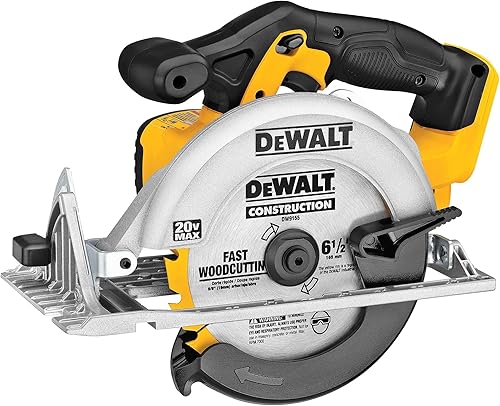
These DEWALT models show the difference between the two tool types. Both are cordless bare tools, so budget for a compatible battery and charger if you don't already have them.

Circular saw vs jigsaw: which cuts does each handle best?
A circular saw handles straight cuts efficiently, while a jigsaw follows changing outlines. Both can cut across a board, but they aren't equally suited to every shape.
A circular saw's round blade follows a straight path through the work. It suits crosscuts across boards, rip cuts along their length and straight cuts through sheet goods.
A jigsaw uses a narrow blade that moves up and down. That blade can turn through a curve, enter an enclosed opening through a starter hole and cut notches without extending a round blade past the corner.
| Project or cut | Better starting tool | Main reason |
|---|---|---|
| Breaking down a plywood sheet | Circular saw | Better suited to long straight paths |
| Cutting straight shelf parts | Circular saw | Easier to guide for repeated straight edges |
| Rounding a panel corner | Jigsaw | Narrow blade can follow a curve |
| Making an enclosed opening | Jigsaw | Blade can enter through a starter hole |
| Cutting a small notch | Jigsaw | More control near inside corners |
| Making long beveled edges | Circular saw | Straight blade path suits guided edge cuts |
These choices assume suitable blades and material within the tool's limits. A saw's blade size alone doesn't tell you its maximum cutting depth, especially when the shoe is tilted.
Circular saw vs jigsaw for small projects
A jigsaw makes sense for small projects with shaped parts. A circular saw makes sense for small projects built from straight rectangles, such as a simple shelf.
Project size doesn't determine how easy the cut will be. A tiny offcut can be harder to secure than a full panel, so plan clamps and blade clearance before choosing either tool.
Who should buy the DeWalt DCS391B circular saw?
The DCS391B suits buyers who regularly cut straight boards and panels. Choose it for shelf parts, storage projects and other work where long edges need to stay straight.
It has a 6-1/2 in blade, a magnesium shoe and a rubber overmolded grip. The shoe provides a base to run against a suitable guide, while the grip gives you a defined place to control the saw.
Its 0–50° bevel adjustment also suits projects with angled edges. Check the required cutting depth at your chosen angle before planning a beveled cut through thick stock.
Pair this saw with a stable support surface and a straightedge when accuracy matters. Our guide to cutting straight with a circular saw explains the setup.
Skip it as your only saw if most projects need curves or enclosed openings. A round blade can't follow those outlines, and its cut extends beyond what you can see at the top surface near an inside corner.
Also reconsider it if you have nowhere to support panels safely. Cordless power removes the cord, but it doesn't remove the need for a clear cutting area.
Who should buy the DeWalt DCS334B jigsaw?
The DCS334B suits buyers making shaped panels, notches and cutouts. It's the more useful first choice when your drawings include curves rather than mostly straight edges.
Its brushless motor drives T-shank blades at up to 3,200 strokes per minute. A variable speed trigger and dial let you adjust blade speed, while 4-position orbital action changes the cutting motion.
The LED and integrated dust blower help keep a marked line visible. A no-mar shoe cover helps protect the surface from scratches, though you should still clear trapped chips before cutting finished material.
Keyless blade changes make it easier to switch between blades suited to different jobs. Choose the blade for the material, thickness and curve radius before setting the controls.
Skip it for production-style straight cutting or long edges that must fit tightly without much cleanup. A jigsaw can follow a straightedge at the shoe while its blade bends below the surface.
It's also a poor substitute for a circular saw when breaking down many large panels. Slower progress and blade drift make that work more demanding.
Which saw leaves a cleaner, squarer edge?
A guided circular saw is usually the better choice for long, square edges. A jigsaw can leave a clean edge, but blade flex becomes a bigger concern in thick stock and tight curves.
Cleanliness and squareness are separate goals. An edge may look smooth from above yet lean away from square underneath, which matters when fitting shelves, joints or matching parts.
Use a sharp blade suited to the material and the finish you need. Fine-cut blades generally favor edge quality over speed, while aggressive blades favor faster removal.
For a jigsaw, reduce orbital action when a cleaner edge matters and use the blade maker's guidance for the material. Push only as fast as the blade can clear the cut without bending.
For either tool, cut scrap from the same material and inspect both faces. Leave a small trimming or sanding allowance when the final outline needs a precise fit.
Avoid assuming that higher speed always makes a cleaner cut. Heat, feed pressure, blade choice and support all affect the edge.
How should you set up a circular saw cut?
Support the work, set the blade depth and position the guide before starting. Keep the blade path clear underneath the material as well as along the visible line.
Use a stable cutting surface that supports the panel without trapping the blade. Arrange the work and offcut so they won't shift, collapse or pinch the blade as the cut ends.
Remove the battery before making adjustments. Set the depth as directed in the manual, with only the needed amount of blade below the work.
Measure the distance between the blade and the edge of the shoe that will follow your straightedge. Clamp the guide at that offset, then confirm that the blade removes the waste side of your mark.
Before starting, check that clamps won't block the saw or force you to change your grip. Use both hands in the positions directed by the manual and keep your body out of the blade's line.
Let the blade reach speed before entering the material, then feed steadily. If it binds, release the trigger, hold the saw still until the blade stops and resolve the cause before restarting.
Our guide on how to use a circular saw covers the basic sequence. Use it alongside the instructions for your exact model.
How should you set up a jigsaw cut?
Choose the blade first, then secure the work and check clearance below it. The blade needs room for its full stroke without striking the bench, clamps or anything behind the panel.
Make sure the blade is seated and secured according to the manual. A bent or loose blade won't reliably follow your mark, even with careful steering.
Keep the shoe flat on the work while cutting. Tilting or lifting it to hurry through a turn reduces support and makes the blade harder to control.
For an enclosed opening, drill a starter hole in the waste area large enough for the blade. Position it so the hole won't damage the edge you intend to keep.
Start with a gentle feed and let the blade establish the cut. Turn gradually, using a blade suited to the curve instead of twisting a wide blade through a tight radius.
Make relief cuts in the waste when a shape needs them. These give waste pieces room to fall away and reduce the need to force the blade around a corner.
Keep hands clear of the underside, where the exposed blade moves. Let the blade stop before lifting the saw from the cut.
What changes when you make bevel cuts?
Both saws can cut bevels, but angled cuts need extra setup and clearance. The DCS334B shoe has detents at 0°, 15° and 30°, plus a positive stop at 45°.
Tilting the shoe changes the cut's position relative to the guide and reduces available depth on a circular saw. Reset your guide offset rather than reusing the position from a square cut.
A jigsaw blade can flex during a bevel cut, so check the angle through the full thickness. A mark on the top face doesn't show whether the lower edge stayed where you intended.
Make a trial cut and check it with a square or angle gauge. Recheck the shoe's locking adjustment before cutting the final part.
What should you check before buying either saw?
Check material thickness, blade options, power equipment and workspace. Buying the right tool type won't help if your intended cut exceeds its capacity or your work can't be secured.
Start with the next few projects you actually plan to build. Note their longest cuts, tightest curves and thickest parts, then compare those needs with the saw manual.
For sheet goods, allow room to support the panel and move through the whole cut. For enclosed openings, check that you can drill a starter hole and reach the cut without hitting supports underneath.
Confirm which blades you'll need beyond the tool itself. A blade for fast wood cutting may be the wrong choice for a finished panel, a tight curve or another material.
Check battery and charger compatibility through DEWALT's manuals and support resources. Include clamps, guides and work supports in your plan rather than treating them as later extras.
Our complete circular saw buying guide explains the wider tool choices. If guided panel work dominates your plans, compare a circular saw with a track saw before deciding.
Which common mistakes should you avoid?
Don't force the blade, rush the setup or ask one saw to make the wrong shape. Most avoidable cut problems start with blade choice, unstable support or excessive feed pressure.
- Steering a circular saw around a curve: use a jigsaw for the curved section instead.
- Pushing a jigsaw harder when it slows: reduce feed pressure and check blade suitability, sharpness and settings.
- Cutting on the wrong side of the mark: account for the blade's kerf, the material it removes.
- Ignoring the underside: inspect for hidden obstructions and make sure the blade has clearance.
- Starting with a loose workpiece: clamp it so movement won't pull your hands toward the cut.
- Forcing a tiny part through an awkward setup: change the workholding method or cut it from larger stock where practical.
Wear eye and hearing protection and manage dust for the material you're cutting. Neither a clear cut line nor a cordless design replaces proper protection and workholding.
How do you care for either saw?
Keep the blade sharp, the shoe clean and the moving parts clear of debris. Remove the battery before changing blades, cleaning or checking adjustments.
Inspect blades for damage and replace them when they no longer cut properly. More feed pressure isn't a useful cure for dull teeth or a bent jigsaw blade.
Brush debris from vents and the shoe without pushing it deeper into the tool. Follow the manual for cleaning products and lubrication, since the wrong treatment can harm parts.
Check a circular saw's guard movement before use and follow the manual if it sticks. Never hold the guard open to work around a problem.
Store blades so their teeth and edges won't strike loose tools. Our guide to changing a circular saw blade explains the replacement process and direction checks.
Circular saw or jigsaw: make the choice from your next project
For the circular saw vs jigsaw decision, count the cuts on your next project. Choose the DCS391B if straight boards and panels make up most of the work; choose the DCS334B if curves and openings are essential.
If you need both shapes, buy the tool that handles the larger share of the work first. Arrange access to the second tool rather than forcing a circular saw through curves or expecting a jigsaw to produce many matching long edges.
For repeated crosscuts at set angles, read our comparison of circular saws and miter saws. If you've settled on a circular saw, compare worm drive versus sidewinder circular saws to choose a layout that suits your work.
Frequently asked questions
Is a circular saw or jigsaw better for beginners?
Choose by project: a circular saw suits straight boards and panels, while a jigsaw suits curves and cutouts. Neither tool is automatically safer for a beginner, so read its manual, clamp and support the work, and make practice cuts on scrap before cutting your project parts.
Can a jigsaw cut straight lines?
Yes, a jigsaw can cut straight lines, especially over short distances with a suitable blade and steady feed; a guide helps steer the shoe, but the blade can still flex below it. Choose a circular saw for repeated long cuts or parts that need straight, square edges.
Can a circular saw cut curves?
No, a standard circular saw should follow a straight path through the material; steering it around a curve can bind the blade and cause kickback. Use a jigsaw with a suitable blade for curved outlines, and make relief cuts where needed instead of forcing a tight turn.
Can both tools make bevel cuts?
Yes, both make bevel cuts within their adjustment ranges; the DCS391B circular saw adjusts from 0° to 50°, while the DCS334B jigsaw has shoe detents at 0°, 15° and 30°, plus a positive stop at 45°. Check the edge on scrap before cutting a part that must fit another.
Do these DEWALT saws include a battery and charger?
No, both are bare tools with the battery and charger sold separately; you'll need compatible power equipment before either saw is ready to use. Check compatibility for the exact model, then include suitable blades, clamps and work supports when planning what you need for your first project.