Circular Saw vs Miter Saw: What Is the Difference? (November 2026)
The circular saw vs miter saw choice comes down to your cuts: choose a circular saw for panels and ripping or a miter saw for repeated crosscuts and trim angles. Buy for your next project and the space needed to support its material.
On this page (10 sections)
- Circular saw vs miter saw: what is the main difference?
- Which saw fits your next project?
- Which of these 3 saws suits your work?
- How much workspace does each saw need?
- How do you set up each saw for accurate cuts?
- What cutting capacity should you check before buying?
- Which saw is easier for beginners?
- What mistakes cause poor cuts or unsafe setups?
- How should you care for either saw?
- Circular saw vs miter saw: which should you buy first?
A circular saw is better for panels and lengthwise cuts, while a miter saw is better for repeated crosscuts and trim angles. The circular saw vs miter saw decision starts with your material, then the space you have to support it.
For plywood shelves, bring a circular saw to the sheet. For a room of baseboard or a batch of matching board lengths, a miter saw gives you a dedicated cutting station.
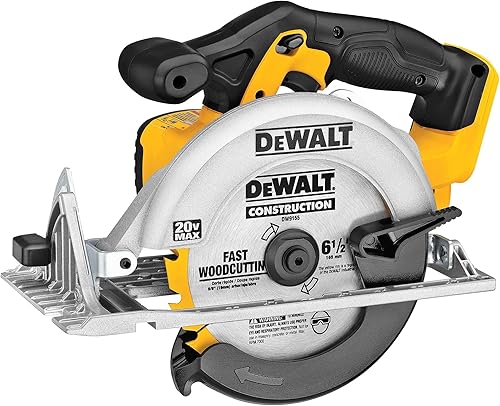

Circular saw vs miter saw: what is the main difference?
A circular saw moves through the workpiece, while a miter saw lowers its blade through stock held against a fence. That layout determines which cuts each tool handles well.
A circular saw's base, also called its shoe, rides on the material. You steer the tool along a line or guide, so it can crosscut a board, rip along its length or break down a sheet.
A miter saw holds the cutting path at a station. Its rotating table sets the crosscut angle, while a compound model also tilts the blade.
A miter cut angles across the board's face; a bevel cut angles through its thickness. A compound cut combines both, as some trim joints require.
| Product | Best for | Power | Blade | Bevel | Our score |
|---|---|---|---|---|---|
| DeWalt DCS391B 20V Circular Saw | mobile DIY work | 20V battery powered | 6-1/2 in | 0–50° | 8.8 |
| Metabo HPT C10FCG2 Miter Saw | garage trim projects | 15-Amp corded electric | 10 in | 8.1 | |
| DeWalt DCS361B Cordless Miter Saw | remote trim work | 20V battery powered | 7-1/4 in | 8.0 |
Neither tool covers every woodworking task. A miter saw cannot replace a ripping tool, and a circular saw needs more guide setup when many short pieces must match.
Which saw fits your next project?
Choose a circular saw for large material and a miter saw for batches of crosscuts. Picture the actual cuts on your project plan before comparing blade sizes or power sources.
Circular saw versus miter saw for plywood and lumber
A circular saw is the useful first choice for plywood cabinet parts, sheathing and boards that need narrowing. You can arrange supports around the material instead of lifting a large panel onto a small cutting table.
It also handles occasional board crosscuts with a suitable guide. Our guide to cutting straight with a circular saw explains how to position the guide and keep the base on course.
Choose a miter saw for picture-frame parts, trim lengths and repeated cuts across boards. Its fence provides a reference edge, so you spend less time positioning a separate guide for each cut.
For a deck, the answer depends on the task. Ripping a board to width favors a circular saw; cutting many boards to length favors a miter saw, provided their dimensions fit its capacity.
Which of these 3 saws suits your work?
The DCS391B suits mobile panel and lumber work, the C10FCG2 suits a corded crosscut station, and the DCS361B suits cordless trim work. Choose the tool layout first, then the model.
DeWalt DCS391B: for bringing the saw to the material
The DCS391B has a 6-1/2 in blade, a magnesium shoe and a 0–50° bevel range. Its cordless layout fits projects where the cutting position moves between supported sheets or boards.
Buy it for varied straight cuts when you can secure the work and guide the saw. The battery and charger are sold separately, so include those in your setup plan.
Skip it as your main tool if nearly every task involves matching trim lengths at a bench. It can make those cuts, but each piece still needs careful alignment and support.
Metabo HPT C10FCG2: for a regular cutting station
The C10FCG2 pairs a 10 in blade with a 15-Amp corded motor. Its miter range reaches 52° left and right, while its single bevel tilts up to 45° left.
Its vice clamping system helps secure stock for crosscuts and angle work. This is a sensible fit for a garage or jobsite station with power nearby and room for board supports.
Skip it if your main work is cutting full sheets or ripping lumber. Also consider the single-bevel layout: some opposing bevel cuts require turning or repositioning the workpiece.
DeWalt DCS361B: for crosscuts away from an outlet
The DCS361B is a 7-1/4 in sliding miter saw with adjustment-free cut-line indication and 11 positive miter stops. It uses DeWalt's 20V MAX battery system.
Choose it when moving a trim station between rooms or work areas makes cord access awkward. The cut-line system helps you position a mark, while the stops simplify returning to common angles.
Skip it if cordless operation adds little value to your routine. At 30 lb, it still needs transport planning, a stable surface and support for long stock.
How much workspace does each saw need?
A circular saw needs room around the material, while a miter saw needs room around a station. Measure the space with a full board in position, rather than considering only the tool's footprint.
For sheet work, you need a supported cutting surface and a clear path along the cut. Plan where both pieces will rest afterward so neither drops unexpectedly or closes the kerf around the blade.
A miter saw needs a firm bench or suitable stand, plus support for long stock at table height. Allow clearance for the head's full movement and any sliding travel specified in the manual.
The Metabo weighs 24.2 lb, but carrying weight is only part of portability. A saw becomes less convenient to move when its stand, stock supports, power supply and material require several trips.
A small shed can favor a circular saw stored between projects. A dedicated garage bay can favor a miter saw that stays ready for repeated work.
How do you set up each saw for accurate cuts?
Support, alignment and blade choice matter more than rushing the cut. Disconnect power before making adjustments that require it, and follow the manual for your model.
Set up a circular saw around the cut line
Start with stable, secured material and a blade suited to the material and finish. Set cutting depth according to the manual, with only the necessary blade projection below the workpiece.
Position your guide using the distance between the blade and the edge of the shoe. Mark the waste side, account for the blade's kerf and make a practice cut in scrap before cutting a finished part.
Clamp the guide where the motor and handle can pass without hitting it. Keep the shoe flat and follow the guide without forcing the blade faster than it can cut.
Our circular saw guide and rail roundup helps you compare guidance options. Use a track only with a saw or adapter designed for that system.
Set up a miter saw around the board
Check the saw's alignment as the manual directs before relying on a scale or stop. A positive stop helps repeat a setting, but a tight-fitting joint still needs a trial cut.
Place the stock flat on the table and firmly against the fence. Keep dust and chips away from those contact surfaces so debris does not change the board's position.
Support long boards at table height without lifting them off the saw table. Use the approved clamp arrangement and check clearance through the full cutting motion before switching on.
For angled trim, label the face, top edge and waste side. This avoids cutting the correct angle in the wrong direction.
What cutting capacity should you check before buying?
Check capacity at the angle you will actually use. Blade diameter alone does not tell you the widest or thickest stock a saw can handle.
For a circular saw, compare cutting depth at 90° and at your planned bevel angle. Tilting the blade reduces available depth, so a board that fits a square cut may not fit the same way at a bevel.
For a miter saw, check both crosscut width and stock height. Capacity changes with miter angle, bevel angle and whether the stock lies flat or stands against the fence.
The DCS361B supports 3-5/8 in nested crown and 3-1/2 in base vertically. Those figures describe specific stock positions, so use the manual's chart for your intended cut.
Do not assume a 10 in blade cuts every 10 in wide board. If your project relies on wide shelving or tall trim, confirm that exact cut before choosing a saw.
Which saw is easier for beginners?
The easier saw is the one that matches the first project. A miter saw simplifies positioning for board crosscuts, while a circular saw gives beginners access to panel and lengthwise cuts.
A miter saw's fixed path reduces steering, but hands still need to stay outside the required clearance zone. Small offcuts, awkward stock and compound angles can complicate the setup.
A circular saw asks you to manage the tool, guide and support together. Begin with a simple square cut on secured scrap before attempting bevels or large panels.
Choose manageable material while learning instead of starting with a heavy sheet that is hard to support. Our circular saw picks for beginners focus on that first-tool decision.
The complete circular saw guide explains the main tool choices. Read how to use a circular saw before planning your first cuts.
What mistakes cause poor cuts or unsafe setups?
The main mistakes are poor support, incorrect alignment and moving material too soon. Fix the setup before blaming the saw.
- Cutting on the wrong side of the mark: The blade removes material, so place the kerf on the waste side to preserve the finished length.
- Letting the board rock: Twisted stock or uneven supports can change its position during the cut.
- Forcing the feed: Excess pressure can pull a circular saw away from its guide or spoil a miter saw cut.
- Trusting an angle mark without a sample joint: Check mating pieces together before cutting the whole batch.
- Trapping an offcut: Use length stops only in arrangements allowed by the manual, with clearance for the separated piece.
- Reaching for scraps before the blade stops: Wait, keep hands clear and follow the saw's shutdown procedure.
A circular saw also needs a supported shoe throughout the cut. Do not try to rescue a drifting cut by twisting the blade sharply while it is engaged.
For a sliding miter saw, use the cutting sequence in its manual. Sliding direction is a safety step, rather than a preference.
How should you care for either saw?
Keep blades, guards and reference surfaces clean and working freely. Disconnect power before cleaning, inspecting or changing a blade.
Check for damaged teeth, a loose blade, a bent shoe or a fence that no longer aligns correctly. Stop using the saw if a guard binds or fails to return as intended.
Remove chips from a miter saw's table and fence before close-fitting work. On a circular saw, clear debris from the shoe and guide so they sit flat.
Use the blade diameter, arbor size and speed rating required by the tool. Our guide to changing a circular saw blade covers that process; your model's manual controls the exact steps.
Wear eye and hearing protection, and use appropriate dust control. Route cords away from the cutting path and store cordless tools and batteries according to their instructions.
Circular saw vs miter saw: which should you buy first?
For the circular saw vs miter saw decision, buy for the cuts on your next project. Choose a circular saw for panel breakdown and ripping, or a miter saw when repeated board crosscuts dominate the work.
Pick the DCS391B when you need to carry the tool to supported material. Pick the C10FCG2 for an outlet-fed cutting station, or the DCS361B when cordless trim work is the priority.
If panel cutting becomes your main task, our circular saw vs track saw comparison explains when a guided system earns its space. For a conventional circular saw, use our guide to choosing a circular saw to match capacity and power to your work.
Frequently asked questions
Is a circular saw or miter saw better for beginners?
A miter saw suits beginners making repeated board crosscuts, while a circular saw suits those starting with plywood or lengthwise cuts. Neither choice removes the need for secure work support and careful setup; pick the tool for your first project, then learn its controls and manual before cutting.
Can a circular saw make miter cuts?
Yes, a circular saw can make miter cuts by following an angled line across a board with a suitable guide; tilting the blade makes a bevel, which is a different cut. For several matching angled crosscuts, a miter saw reduces the need to position a separate guide each time.
Can a miter saw cut a long board lengthwise?
No, a miter saw is designed to crosscut stock within its cutting capacity, rather than rip a long board lengthwise. Use a circular saw with a suitable guide or another tool designed for ripping; support the board so the cut stays open and both pieces remain stable.
Do you need both a circular saw and a miter saw?
You need both only when your projects regularly combine panel or lengthwise cuts with repeated board crosscuts. Start with the tool that handles your next project's main task; add the second when it saves enough measuring, guide setup or material handling to justify its storage and support needs.


