8 Best Circular Saws for Beginners (November 2026)
The best beginner circular saws include the DeWalt DCS391B 20V Circular Saw for DeWalt battery owners, the DeWalt DCS571B 4-1/2 Inch Circular Saw for small project spaces, and the Skil 5280-01 Corded Circular Saw for first workshop projects.
On this page (7 sections)
- How we chose the best circular saw for beginners
- Which beginner saw fits your projects?
- How do you choose a first circular saw?
- How should you set up your first cuts?
- Which beginner mistakes spoil cuts or damage blades?
- How do you care for a first circular saw?
- Which is the best circular saw for beginners in your situation?
The best circular saw for beginners is the DeWalt DCS391B if you already own compatible 20V MAX batteries. If you're starting without a battery system and have a nearby outlet, the Skil 5280-01 is the more direct route to a full-size workshop saw.
Choose around your first projects: shelf boards, framing lumber or plywood panels. Material thickness, cutting angle and a secure place to work matter more than choosing the saw with the highest motor speed.
For setup and basic technique, read our guide on how to use a circular saw. If straight cuts are your main concern, see how to cut straight with a circular saw.
Our picks at a glance
-
1
-
2
 Best for small project spaces
DeWalt DCS571B 4-1/2 Inch Circular Saw
8.6/10 our score
See it on Amazon -
3
- 4
 Check it
Ryobi ONE+ P505 5-1/2 Inch Circular Saw
Best for Ryobi battery owners - 5
 Check it
Skil 5080-01 Corded Circular Saw
Best for occasional workshop users - 6
 Best for regular framing projectsCheck it
- 7
 Check it
DeWalt DCS512B 12V 5-3/8 Inch Circular Saw
Best for DeWalt 12V users - 8
 Check it
Skil 5180-01 Corded Circular Saw
Best for weekend wood projects
How we chose the best circular saw for beginners
We favored useful cutting capacity, manageable controls and a clear view of the cut. Battery compatibility also matters because a highly ranked tool-only saw can be the wrong first purchase for someone starting from scratch.
PliersPal compared the features, accessories and cutting limits for common first projects. Each recommendation identifies a buyer fit, with trade-offs that matter before you commit to a power system or blade size.
| Product | Best for | Blade size | Power | Bevel | Our score |
|---|---|---|---|---|---|
| DeWalt DCS391B 20V Circular Saw | DeWalt battery owners | 6-1/2 in | Battery powered; battery and charger sold separately | Up to 50 degrees | 8.8 |
| DeWalt DCS571B 4-1/2 Inch Circular Saw | small project spaces | 4-1/2 in | Battery powered; battery sold separately | 45-degree bevel cuts in 1x lumber | 8.6 |
| Skil 5280-01 Corded Circular Saw | first workshop projects | 7-1/4 in | Corded electric | Up to 51 degrees; positive stop at 45 degrees | 8.2 |
| Ryobi ONE+ P505 5-1/2 Inch Circular Saw | Ryobi battery owners | 5-1/2 in | Battery powered; battery not included | Up to 50 degrees | 8.0 |
| Skil 5080-01 Corded Circular Saw | occasional workshop users | 7-1/4 in | Corded electric | Up to 51 degrees; positive stop at 45 degrees | 7.9 |
| Makita 5007F Circular Saw | regular framing projects | 7-1/4 in | Corded electric | Up to 45 degrees | 7.9 |
| DeWalt DCS512B 12V 5-3/8 Inch Circular Saw | DeWalt 12V users | 5-3/8 in | Battery powered; battery and charger sold separately | Up to 50 degrees | 7.7 |
| Skil 5180-01 Corded Circular Saw | weekend wood projects | 7-1/4 in | Corded electric | Up to 51 degrees; positive stop at 45 degrees | 7.6 |
Which beginner saw fits your projects?
Choose a saw that handles your planned cuts and fits your workspace. The cordless picks serve different battery owners and project sizes, while the corded models suit work near an outlet.
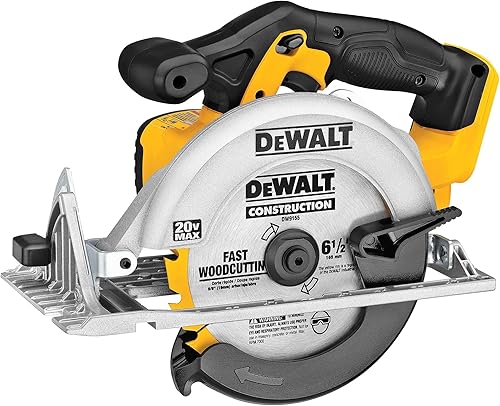
DeWalt DCS391B 20V Circular Saw: Best for DeWalt battery owners
- 6-1/2 in blade
- Magnesium shoe
- Comfort grip
- Bevel capacity up to 50 degrees
A middle-size cordless choice for beginners who already use compatible DeWalt batteries. Its magnesium shoe and overmolded grip support a practical first-saw setup.
Pros
- Magnesium shoe
- Overmolded comfort grip
- Up to 50-degree bevel capacity
Cons
- Battery and charger sold separately
- Requires a compatible DeWalt battery
The DCS391B is the strongest fit here for a beginner who already has compatible DeWalt batteries and wants a general woodcutting saw. Its 6-1/2 in blade sits between the compact models and the full-size corded options.
The magnesium shoe provides the surface that rides on your workpiece. DeWalt designs it for durability and long-term cut accuracy, while the overmolded grip is intended to support balance and control.
That combination suits someone learning board crosscuts and straight cuts in panels without managing a power cord. A firm shoe position and secure work support still determine how steadily you can move through the cut.
Buy it if your existing battery setup and planned material make it a sensible match. Skip it if you're starting without batteries and will work beside an outlet, since the battery and charger are separate purchases.
Before choosing it for thicker lumber or angled work, confirm the required cutting depth. Blade diameter alone is not a capacity measurement.
DeWalt DCS571B 4-1/2 Inch Circular Saw: Best for small project spaces
- 4-1/2 in blade
- Removable auxiliary handle
- Electronic blade brake
- On-board dust port
A compact choice for smaller wood projects, with a second handle and electronic blade brake. DeWalt specifies square cuts through 2x lumber and 45-degree bevel cuts through 1x lumber.
Pros
- Removable auxiliary handle
- Electronic blade brake
- Dust port adaptor and rip fence included
Cons
- Battery sold separately
- 45-degree cutting capacity is limited to 1x lumber
Choose the DCS571B for smaller projects where a compact saw suits the work area. Its removable auxiliary handle gives you a second grip point, which is valuable while learning to keep the shoe flat.
DeWalt specifies square cuts through 2x material and 45-degree bevel cuts through 1x material. Those are useful limits: it can suit basic lumber cuts, but its angled-cut capacity is narrower than its square-cut capacity.
The electronic blade brake stops the blade quickly after release. Wait for a complete stop before setting it down, and keep the auxiliary handle fitted when the manual calls for it.
A dust port adaptor and rip fence are included, giving you accessories to plan around as your projects grow. A fence helps with suitable edge-following cuts; it does not replace stable support.
Buy it for projects that fit those limits, especially within an existing 20V MAX setup. Skip it when thicker bevel cuts are central to your plans or when you need greater cutting depth.
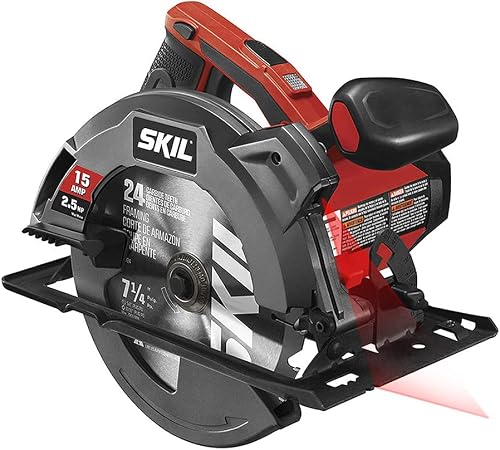
Skil 5280-01 Corded Circular Saw: Best for first workshop projects
- 15-amp motor
- 7-1/4 in blade included
- Single-beam laser guide
- Dust blower
A full-size corded option for beginners working near an outlet. The laser provides a cut reference, and the dust blower helps keep the marked line visible.
Pros
- Laser guide
- Dust blower
- Blade and carry bag included
Cons
- Cord needs a clear route
- 8.7 lb weight may affect handling comfort
The Skil 5280-01 suits a beginner setting up a workshop near an outlet. Its 15-amp motor and included 7-1/4 in carbide blade provide a full-size corded starting point without a battery purchase.
The single-beam laser offers a reference along the cut, while the blower helps clear loose sawdust. Use the laser alongside a marked line and a properly placed guide rather than expecting it to steer the saw.
Its bevel adjustment reaches 51 degrees, with a positive stop at 45 degrees. Start with square cuts and check the angle on scrap before moving to joints where small errors leave visible gaps.
At 8.7 lb, this is heavier than the other Skil models here. Consider how comfortably you can hold both handles and reach the controls before making weight a secondary concern.
Choose it for repeat board and panel work with room to route a cord. Skip it if moving between areas without outlets is a core requirement.
Ryobi ONE+ P505 5-1/2 Inch Circular Saw: Best for Ryobi battery owners
- 5-1/2 in blade
- Extra side handle
- Clear lower guard
- Bevel adjustment up to 50 degrees
A smaller cordless saw for household projects on an existing Ryobi ONE+ setup. The extra handle and clear lower guard help with grip and sight of the work.
Pros
- Extra side handle
- Clear lower guard
- Compatible with Ryobi ONE+ 18V batteries
Cons
- Battery not included
- Cutting capacity needs checking for thicker projects
The Ryobi P505 makes the most sense for existing Ryobi ONE+ users doing household wood projects. Reusing a compatible battery avoids adding another power system just for a first saw.
Its extra side handle gives you another place to hold the tool, and the clear lower guard helps preserve your view of the work. Neither feature changes the need to keep hands away from the blade path.
The 5-1/2 in blade offers a smaller format than the full-size corded picks. Check cutting depth for your planned boards and bevels before assuming the smaller saw can cover every future project.
This is a good match when your jobs fit its capacity and cordless movement matters. Skip it if you need a confirmed deeper cut or do not want to build a Ryobi battery setup.
Before your first cut, check that the guard moves freely and returns as the manual describes. Keep it clean enough to preserve visibility, and never hold it open for routine cutting.
Skil 5080-01 Corded Circular Saw: Best for occasional workshop users
- 13-amp motor
- 7-1/4 in blade
- 7 lb weight
- Dust blower
A straightforward corded choice for occasional shelving and wood projects. Its 7 lb weight is lower than either of the other Skil saws here.
Pros
- Dust blower
- Spindle lock and blade wrench
- Positive bevel stop at 45 degrees
Cons
- Cord limits movement
- Requires an outlet near the work area
Choose the Skil 5080-01 for occasional workshop projects when you want a straightforward corded saw. Its 7 lb weight is lower than the other Skil options here, making it worth considering if handling comfort leads your shortlist.
It pairs a 13-amp motor with an included 18-tooth carbide blade. That gives you a starting setup for wood projects, although blade choice should change with the material and finish you need.
The dust blower helps keep your mark visible, and the spindle lock supports blade changes. Disconnect the cord before using the lock or reaching near the blade.
This model suits basic board cutting, shelving parts and learning guide-assisted cuts near an outlet. It also avoids the need to keep a tool battery charged between occasional projects.
Skip it if you need cordless movement or specifically want the laser reference on the 5280-01. Choose for the work and handling you need rather than assuming a higher amp number automatically makes a better first saw.
Makita 5007F Circular Saw: Best for regular framing projects
- 7-1/4 in blade included
- Two built-in LED lights
- Dust blower
- 15-amp motor
A corded option for beginners planning regular lumber and sheet-cutting work. Built-in lights, clear adjustment markings and stated cutting depths help with setup.
Pros
- Two built-in LED lights
- Dust blower
- Shaft lock for blade changes
Cons
- Requires cord management
- Bevel adjustment stops at 45 degrees
The Makita 5007F is a good fit for a beginner planning regular framing and panel projects. Its built-in lights, dust blower and easy-to-read adjustment markings offer useful help with seeing and setting a cut.
Its cutting depth reaches 2-3/8 in at 90 degrees and 1-3/4 in at 45 degrees. Those measurements give you clear limits for comparing thicker material and angled cuts.
The saw includes a 24-tooth framing blade, and its shaft lock assists with blade replacement. Makita also uses a flat motor housing to provide stability during blade changes.
Choose it when you expect repeated workshop use and value illuminated cut marks. The lights help you see, but you still need adequate room lighting to spot clamps, supports and the cord.
Skip it if portability without an outlet is essential or your work requires bevel settings beyond 45 degrees. Its framing focus is useful for regular lumber work, but a compact saw may better match a small-project routine.
DeWalt DCS512B 12V 5-3/8 Inch Circular Saw: Best for DeWalt 12V users
- 5-3/8 in blade
- Brushless motor
- Tool-free bevel lever
- Built-in rafter hook
A compact option for beginners already using compatible DeWalt 12V MAX batteries. Check angled cuts carefully because cutting depth drops as the blade tilts.
Pros
- Brushless motor
- Tool-free bevel adjustment
- Built-in rafter hook
Cons
- Battery and charger sold separately
- Maximum depth at 45 degrees is 1-1/4 in
The DCS512B is a sensible choice for beginners already using DeWalt 12V MAX batteries. It belongs on your shortlist when compact handling matters and your planned cuts stay within its depth limits.
Its maximum depth is 1-3/4 in at 90 degrees, dropping to 1-1/4 in at 45 degrees. That difference matters if your first project combines square board cuts with beveled edges.
The tool-free bevel lever simplifies angle changes, while the rafter hook provides a storage option. Make angle adjustments with the battery removed, then secure the lever before reconnecting power.
Buy it for smaller wood projects within an existing compatible setup. Do not assume that owning DeWalt 20V MAX batteries also supplies the power system this 12V MAX saw needs.
Skip it if thicker angled cuts are part of your plan. The battery and charger are sold separately, so someone starting from scratch should compare the complete setup with a corded alternative.
Skil 5180-01 Corded Circular Saw: Best for weekend wood projects
- 14-amp motor
- 7-1/4 in blade included
- Dust blower
- 51-degree bevel capacity
A corded saw for routine lumber cuts and plywood projects near an outlet. It includes a carbide blade, wrench and dust blower without requiring a battery setup.
Pros
- 20-tooth carbide blade included
- Dust blower
- Spindle lock and on-tool wrench
Cons
- Cord limits movement
- Slightly heavier than the Skil 5080-01
The Skil 5180-01 suits weekend lumber and plywood projects in a fixed work area. It offers corded power with an included 20-tooth carbide blade, so you can focus your setup planning on work support and accessories.
Its 14-amp motor, dust blower and spindle lock cover the main features many first projects call for. The wrench stores on the tool, keeping it accessible when you need to fit another blade.
At 7.2 lb, it sits close to the lighter Skil option here. Treat that small weight difference as one factor alongside grip access and how easily you can read the depth and bevel controls.
Choose it for routine woodcuts where a nearby outlet makes corded power practical. Skip it if you specifically want the 5280-01's laser guide or need to carry the saw between areas without power.
For occasional use, store the wrench securely and inspect the cord before each session. A simple saw still needs the same careful support and cut planning as a more feature-rich model.
How do you choose a first circular saw?
Start with material thickness, cutting angle and workspace, then choose the power source. These decisions narrow the field more usefully than motor speed or the number of extra features.
What makes the best circular saw for a beginner?
The best fit lets you hold both handles comfortably, reach the controls and see the cut without leaning into the blade path. A smaller blade does not automatically mean easier or safer handling.
With power disconnected, check how the shoe sits on a board and how clearly you can read the adjustment marks. Your complete circular saw buying guide explains how blade size and saw type affect the choice.
Check cutting depth at the angle you need
Use actual material thickness, then compare it with the saw's capacity at your intended angle. Beveling reduces usable cutting depth, so a saw that clears a board squarely may not clear it when tilted.
Nominal lumber names do not describe exact dimensions. Measure your stock rather than choosing a saw because its blade diameter appears larger than the board's name.
Choose corded or cordless around your workspace
Choose corded when you can arrange a fixed cutting area near power. Choose cordless when you need to move between work areas or already have compatible batteries and a charger.
A tool-only saw needs more than the tool before work can begin. For corded use, select an extension cord rated as the saw's manual requires, and keep its route clear of the cut.
Match the blade to the material and finish
Choose a blade with the correct diameter, arbor fit, speed rating and intended material. Within blades suitable for the job, tooth count and tooth design influence how quickly and cleanly the saw cuts.
A framing blade can suit rough construction cuts, while visible plywood edges may call for a finish-focused blade. Do not use a wood blade on other materials unless the blade and saw instructions expressly allow it.
Decide whether a circular saw fits the cut
A circular saw is a good first choice for straight board and panel cuts. Curves and many cutouts call for a different approach.
If your project includes curved shelf shapes or openings, read circular saw vs jigsaw before buying. Choosing the right kind of saw saves more trouble than adding features to the wrong one.
How should you set up your first cuts?
Make your first cuts on scrap material with stable support and a clear blade path. Read the manual before powering the saw, including its instructions for the guard, depth adjustment and kickback prevention.
Support the work without pinching the blade
Secure the workpiece so it cannot slide or twist, and arrange support so the cut stays open. Poor support can let material sag and squeeze the blade, increasing the risk of kickback.
Keep the blade clear of benches, supports and clamps below the work. Never hold a board against your body or reach underneath it while the saw is connected to power.
Set depth and check the controls
Disconnect power and set the blade to project only as far below the material as the manual directs. Tighten the depth and bevel locks, then check that the lower guard moves freely and returns properly.
Mark the waste side of the line before cutting. The blade removes a strip of material called the kerf, so cutting down the center of a finished-size mark can leave your part too short.
Set a guide before chasing a long line
For a long straight cut, clamp a suitable straightedge at the correct offset from the blade. With power disconnected, check the saw's travel for clamp clearance, support and enough room for its motor housing.
A laser, light or blower helps visibility but does not provide a physical fence. Our DIY track saw guide explains how to plan guide-assisted cuts.
Start and finish without forcing the saw
Keep the blade clear of the material when starting, let it reach operating speed, then feed steadily. Use the handles as directed and stand clear of the likely kickback path.
If the saw binds, slows sharply or wanders, release the trigger and keep it controlled until the blade stops. Disconnect power before checking the blade, support or setup.
Wear eye and hearing protection, and use dust protection appropriate to the material and work area. OSHA's woodworking guidance explains common hazards and safeguards.
Which beginner mistakes spoil cuts or damage blades?
The most avoidable problems come from poor support, the wrong blade and trying to force the cut. Check the setup before blaming the saw's power.
Steering back onto the line
Twisting a running saw sideways to correct drift can bind the blade. Stop, let the blade come to rest and disconnect power before correcting your setup.
For finished parts, practice the guide position on scrap first. Confirm that the blade cuts on the waste side and that the remaining piece reaches your intended dimension.
Ignoring hidden fasteners
Inspect reused boards for nails, screws and other embedded objects before cutting. A blade intended for wood should not be treated as a way through unknown hardware.
Check the underside as well as the visible face. Also look for grit or debris that could interfere with the shoe or damage a cutting edge.
Using a dull or dirty blade
A blade that needs excessive pushing, leaves burn marks or cuts poorly deserves inspection. Stop and disconnect power before checking for damaged teeth, buildup or an unsuitable blade.
Clean blades only with methods and cleaners approved for them. Replace damaged blades, and never try to solve a poor cut by pushing harder.
How do you care for a first circular saw?
Keep the guard, shoe, blade and power connection clean and in sound condition. A brief check before storage makes the next setup easier.
Disconnect power before brushing away loose sawdust, and follow the manual for vents and other cleaning points. Avoid forcing debris into the motor or applying lubricant where the manufacturer does not call for it.
Inspect the shoe for damage and check that adjustment locks hold firmly. A loose setting can change depth or angle during a cut.
For blade replacement, follow the exact instructions for your model and verify blade direction before reconnecting power. Our guide on how to change a circular saw blade covers the process and common errors.
Store the saw dry and protected from knocks, with the guard covering the blade. Care for batteries and chargers according to their manuals, including storage and charging conditions.
Which is the best circular saw for beginners in your situation?
The best circular saw for beginners is the one that covers your next projects with a power system you can support. Write down the thickest material and steepest bevel you need before choosing.
Pick the DCS391B for an existing compatible DeWalt 20V MAX setup. Choose the Skil 5280-01 for a first corded workshop saw, or the DCS571B when its smaller format and cutting limits suit your work.
Ryobi battery owners should consider the P505; DeWalt 12V users should consider the DCS512B. For regular framing work, look closely at the Makita, while the other Skil models suit straightforward corded projects.
If you're still deciding among full-size models, compare the best corded circular saws and best circular saws overall. Leave room in your setup for a suitable guide, clamps and stable work support before making your first finished cut.
Our top 3 picks at a glance
-
1
-
2
Best for small project spaces
DeWalt DCS571B 4-1/2 Inch Circular Saw
8.6/10 our score
See it on Amazon -
3
Frequently asked questions
What size circular saw is easiest for a beginner?
The easiest size is one you can control that also cuts through your material at the required angle; compact saws can suit small projects, while full-size models offer another route for lumber and sheet goods. Check actual cutting depth, grip comfort and adjustment access before choosing by blade diameter alone.
Should a beginner buy a corded or cordless circular saw?
Choose corded for a fixed workspace near an outlet, especially if you do not own tool batteries; choose cordless for moving between work areas or adding to a compatible battery system. Compare the complete setup, including a charger, suitable battery or extension cord, before deciding which route fits your projects.
Is a laser guide enough to cut straight?
A laser provides a visual reference, but it cannot keep the saw from drifting sideways; for a long straight cut, clamp a suitable guide at the correct distance from the blade. Support the material, check clamp clearance and practice on scrap to confirm which side of your mark the blade removes.
What safety steps should a beginner take?
Read the manual, wear eye and hearing protection, secure the material and keep both hands clear of the blade path; support the work so the cut cannot close on the blade. Disconnect power before adjustments, and wait for the blade to stop before setting the saw down.
Do beginners need a 7-1/4 in circular saw?
No, beginners need enough cutting capacity for their projects rather than a particular blade size; a smaller saw can suit boards and other work within its limits. Choose a larger model when your material thickness or bevel cuts require it, and confirm the cutting depth at the angle you plan to use.


