How to Use a Circular Saw
To learn how to use a circular saw, support and clamp the work, set the blade depth, and feed the saw steadily with both hands on its handles. Wear eye and hearing protection, and follow your saw’s manual.
On this page (10 sections)
- What safety steps come before the first cut?
- How should you support boards and sheet goods?
- How do you set blade depth and check alignment?
- How do you mark and guide a straight cut?
- How do you use a circular saw for your first cut?
- What changes for rip cuts and bevel cuts?
- Which blade and corded saw suit home projects?
- What mistakes cause binding, kickback, and rough edges?
- What care does a circular saw need after use?
- Which setup should you choose to learn how to use a circular saw?
Learning how to use a circular saw starts with supporting and clamping the work, setting the blade depth, and feeding the saw steadily with both hands on its handles. Wear eye and hearing protection, and follow your saw’s manual.
Start with a straight crosscut on scrap wood before tackling long rips or bevels. Your first goal is to finish the cut with the shoe flat, the material stable, and your body clear of the blade line.
What safety steps come before the first cut?
Check the guard, blade, and work area before connecting power. Wear eye and hearing protection, secure loose clothing and hair, and use suitable dust protection for the material.
With the saw unplugged or its battery removed, check that the lower guard moves freely and returns as directed in the manual. Never tie it open or use a saw with a damaged guard.
Inspect wood for screws, nails, and other hidden objects. Keep bystanders away, and never hold a board in your hand, across your knees, or against your body while cutting.
Stand to one side of the blade line with balanced footing. Keep both hands on the handles during the cut, and never reach underneath the workpiece.
How should you support boards and sheet goods?
Support the material so it stays flat and cannot pinch the blade. A stable bench or suitable supports must leave clearance for the blade beneath the entire cut.
For a board crosscut, secure the keeper piece and let the waste separate without trapping the blade. Avoid a setup where both ends rest on supports but the middle sags as you cut.
For plywood, use supports beneath the sheet on both sides of the cut. A suitable sacrificial surface can support the sheet across its area, provided blade depth and clearance are set correctly.
Clamp clear of the saw’s travel, including the motor housing and handles. Before connecting power, check that you can reach the full cut without stretching or losing your footing.
How do you set blade depth and check alignment?
Set depth to expose only the blade projection your manual calls for below the material. Disconnect power, adjust the shoe, and lock the depth lever before checking clearance underneath.
Excess depth leaves more blade exposed and makes safe support harder. Too little depth leaves an uncut layer that can tear when the pieces separate.
Check that the blade is secure, undamaged, and fitted in the correct direction. Our guide to which way a circular saw blade goes explains the rotation markings.
For square cuts, confirm the bevel setting is locked at zero. If the angle matters for a joint, check a cut on scrap rather than relying only on the scale.
How do you mark and guide a straight cut?
Put the blade on the waste side of the mark and use a clamped guide for long cuts. The blade removes a strip of wood called the kerf, so cutting down the center of your mark can leave the keeper short.
Measure the distance between the blade and the shoe edge that will follow your straightedge. Check that offset on scrap with the same blade and angle before cutting the finished piece.
The Milescraft suits readers who already have a compatible saw and need guided sheet cuts. It fits most circular saws with blades up to 7-1/4 inches, but most worm drive models are incompatible.
Skip it if you mainly make short crosscuts or need longer cuts without buying extensions. Follow its mounting instructions, adjust the base fit, and use the included clamps where needed to secure the rail.
See how to cut straight with a circular saw for setup details. Our circular saw guide and guide rail picks help you compare other guide options.
How do you use a circular saw for your first cut?
Start with the blade clear of the wood, reach full speed, and feed forward without forcing the saw. Keep the shoe flat and maintain control as the blade exits.
How to use a circular saw step by step
- Secure the material and check blade clearance underneath.
- Arrange the cord behind the saw, away from the cut and anything that could snag it.
- Rest the front of the shoe on the work, with the blade clear.
- Grip both handles, align with the waste side, and start the saw.
- Let it reach full speed, then advance steadily along the guide.
- Complete the cut, release the trigger, and wait for the blade to stop.
- Confirm the lower guard covers the blade before setting the tool down.
Don't twist the saw to chase a drifting line. Stop and correct the setup with power disconnected if you cannot continue along the intended path.
If the motor slows sharply, stop pushing. A dull blade, poor support, or excessive feed pressure needs attention before you continue.
What changes for rip cuts and bevel cuts?
Rip cuts need steady guidance; bevel cuts need a fresh depth and clearance check. A rip follows the wood grain, while a crosscut goes across it.
Use a straightedge or compatible rail for long rips. Never reach across the blade path to hold a narrow strip, and choose another cutting setup if the piece cannot be secured safely.
For a bevel, disconnect power, set and lock the angle, then recheck depth. The blade’s path and guide offset can change when tilted, so make a practice cut before cutting to a finished dimension.
The DeWalt suits users moving between cutting stations or working where a cord would snag. Its magnesium shoe and rubber overmolded grip are useful features to consider alongside its 0 to 50 degree bevel range.
Skip this bare tool if you want a complete powered setup in one box: the battery and charger are sold separately. Check blade capacity against your material thickness, especially for angled cuts.
Use our circular saw buying guide to compare saw types. The circular saws for beginners guide focuses on choosing a manageable first tool.
Which blade and corded saw suit home projects?
Choose the blade for the material and finish, then choose a saw you can control. Correct diameter, arbor fit, and speed rating matter more than buying the highest tooth count.
Fewer teeth generally suit faster lumber cuts, while more teeth often give cleaner sheet edges. Only use blades and materials approved in your saw’s manual, and disconnect power before every blade change.
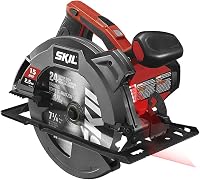
The Skil 5280-01 suits home users cutting lumber and sheet goods near an outlet. Its dust blower helps keep the cut mark visible, while its laser provides a visual reference rather than physically guiding the shoe.
Skip it if managing an extension cord would interfere with your workspace. Don't choose it for the laser alone, since a clamped guide still does the work of keeping a long cut on course.
The Skil 5080-01 suits occasional shelving and general wood projects in a fixed work area. It has a 13-amp motor, a dust blower, and a spindle lock for blade changes.
Skip it if you need cordless movement or specifically want the 5280-01’s laser feature. Compare grip, shoe visibility, and your blade needs before treating motor amperage as the deciding factor.
For the removal and fitting sequence, follow how to change a circular saw blade. Our guide to how to choose a circular saw helps match the tool to your projects.
What mistakes cause binding, kickback, and rough edges?
Pinched wood, a twisted saw, and a dull blade are problems to correct before continuing. Kickback can occur when the blade binds and the saw moves back toward the operator.
If the blade binds or the saw kicks back, release the trigger and hold the tool firmly until it stops. Never pull it backward through the cut with the blade moving.
Disconnect power before checking support, blade condition, and alignment. Follow the manual’s restart procedure, including centering the blade in the kerf with its teeth clear before restarting.
For cleaner plywood edges, use a sharp finish blade and try placing the finished face down. Check the result on secured scrap because veneers, coatings, and guides affect tear-out.
Don't force a slow cut or keep going when dust hides your mark. Stop safely and clear the obstruction before continuing.
For repeated sheet cuts, DIY track saw guides explains what a guided circular saw setup can offer.
What care does a circular saw need after use?
Disconnect power before cleaning, inspecting, or storing the saw. Clear dust from vents, the shoe, and the guard area as directed in the manual.
Check for chipped teeth, pitch buildup, loose adjustments, and cord damage. Follow approved blade-cleaning instructions, and keep oil or cleaners away from parts where the manual forbids them.
Store the tool dry with the blade guarded and the cord protected. Follow battery storage instructions, and replace damaged parts before the next job.
Which setup should you choose to learn how to use a circular saw?
Choose around your workspace and cuts: cordless for movement, corded for outlet-based work, and a guide for long straight cuts. Learning how to use a circular saw is easier when the tool and support arrangement fit the task.
Pick the DeWalt if battery-powered movement matters and you have allowed for a battery and charger. Choose the Skil 5280-01 for its corded setup and visual aids, or the 5080-01 for occasional workshop cuts.
Add the Milescraft only after confirming compatibility and the length you need. Before your first full sheet, use our straight-cut setup guide to position the guide and check the cut on scrap.
Frequently asked questions
How deep should a circular saw blade be set?
Set the blade so it projects only as far below the material as your saw’s manual directs. Disconnect power before adjusting it, lock the depth lever, and check clearance underneath.
Recheck depth after changing the bevel angle, since tilting the blade reduces the thickness it can cut.
How do you make a straight cut with a circular saw?
Clamp a straightedge at the correct shoe-to-blade offset, or fit a compatible guide rail according to its instructions. Position the blade on the waste side of your mark.
Keep the shoe flat, feed steadily, and arrange supports so the material cannot shift or close on the blade.
Should the good side of the wood face up or down?
For a conventional handheld circular saw cutting from above, placing the finished face down generally reduces visible tear-out on that face. Blade choice and surface finish also affect the edge.
Make a practice cut on secured scrap, and follow any face-orientation instructions supplied with your saw or guide.
Can a beginner use a circular saw?
A beginner can learn to use a circular saw with the manual, a stable work area, and practice on secured scrap, ideally with an experienced person providing instruction. Start with simple crosscuts.
Choose a saw you can hold securely with both hands, and learn its guard and trigger controls before connecting power.