DIY Track Saw: Can a Guide Rail Do the Job?
A DIY track saw setup works for straight cuts when your circular saw fits the guide and the work is supported. Choose a guided saw base for rail travel or a clamp edge for simpler occasional cuts.
On this page (8 sections)
- Can a guide rail turn a circular saw into a DIY track saw?
- What can a DIY track saw setup do well?
- Which guide suits your saw and projects?
- What should you check before buying a circular saw guide?
- How do you set up a guide rail for a straight cut?
- Which mistakes spoil guided cuts?
- How do you care for a saw guide?
- Is a DIY track saw setup right for you?
A DIY track saw setup can make straight cuts with a compatible circular saw and guide, making it useful for shelves, plywood panels, and door trimming. It guides the cutting path, but it does not add a plunge mechanism to a standard saw.
The best choice depends first on your saw, then on your longest cut and how often you'll set up the guide. For the wider tool choice, see circular saw vs track saw.
Can a guide rail turn a circular saw into a DIY track saw?
A guide can provide a straight cutting path, but different guide types control the saw in different ways. Choose the type before comparing lengths.
A clamp edge gives the saw base a straight fence to follow. You must keep the base against that fence throughout the cut, and the fence usually sits away from the marked blade line.
A guide with an attached saw base runs along a rail. Fit and adjustment matter because excess play lets the saw move sideways, while an overly tight fit can cause binding.
A rail built for plunge saws requires a compatible saw or a specified adapter. A familiar brand name or a long rail does not mean your standard circular saw will fit.
For occasional straight cuts, these systems can be enough. If you need interior cutouts or frequent plunge cuts, consider whether a dedicated track saw is worth it for your work.
What can a DIY track saw setup do well?
Guides are most useful for breaking down sheet goods and cutting straight panel edges without moving a large sheet across a stationary saw. They also help when a freehand cut would leave too much trimming afterward.
Crosscuts for shelves and long rips for cabinet panels are sensible uses. A guide can also help with door trimming, provided the saw has enough cutting depth with the guide fitted.
It won't make an out-of-square layout square. Mark from a reliable reference edge and check the planned cut before securing the rail.
Nor will it correct a dull blade or poor support. Our circular saw buying guide explains the saw features that matter beyond the guide.
Will a DIY track saw reduce splintering?
A cutting strip can help support the edge beside the blade, but blade choice and workpiece support still affect the finish. Milescraft says its red cutting strip helps reduce splintering and chipping.
Use a sharp blade suited to the material, and follow the guide's instructions for preparing any cutting strip. Make a scrap cut to check edge quality before cutting a visible cabinet side or shelf.
Which guide suits your saw and projects?
Choose a guide that fits your existing saw before paying for extra length. The 4 options below serve different buyers, including people who already have a plunge saw.
Makita: for an existing compatible saw
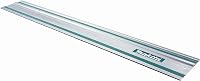
The Makita rail suits owners of those plunge saws who need a rail for sheet material or straight and bevel cuts. Its interaction with the saw base makes compatibility the main buying reason.
For a standard circular saw, confirm that your exact model works with the required adapter before choosing it. Skip this rail if you want a broadly compatible guide without a separate saw adapter.
Milescraft: for adapting a standard circular saw
Milescraft is the clearest fit here for a DIY buyer who wants an attached saw base traveling along rails. It includes T-Track clamps, anti-slip strips, and glide adjusters to set the base's travel tension.
Its all-metal base and rail construction suits buyers who want this style of guided setup. Skip it for most worm drive saws, and confirm fit rather than treating “universal” as a promise for every saw.
Plan extensions before buying for long rips. Joining 2 complete 1409 systems still requires additional rail connectors.
BORA: for occasional long straight cuts
BORA suits buyers who want a long fence for a circular saw rather than an attached saw carriage. Its clamp handle allows adjustment from one side, which helps when reaching across a panel is awkward.
Measure the blade-to-base offset and keep the base against the edge while cutting. Skip this style if you specifically want the guide to capture the saw's travel along a rail.
WEN: for extending a compatible track saw setup
WEN suits owners of compatible track saws who need long-cut capacity from sections that separate for storage. Its connecting adapter set uses 4 set screws, so careful joint alignment belongs in the setup routine.
The CT992F clamps are sold separately. Skip this set as a conversion for an ordinary circular saw: its connecting adapters join the tracks, rather than supplying a universal circular saw base.
What should you check before buying a circular saw guide?
Check the complete setup, including fit, usable travel, depth, and required extras. A rail's overall length is only part of the decision.
- Exact saw fit: Confirm the model, base shape, blade size, and any excluded saw styles.
- Usable cutting range: Allow room for the saw to start and finish with the support the system requires.
- Depth on the guide: A raised base or rail can reduce how far the blade reaches through the work.
- Required extras: Count adapters, clamps, extensions, and connectors needed for your actual projects.
- Storage: Consider where a long assembled guide will live and how often you'll need to join sections.
For an occasional shelf project, a simple fence may be enough. For repeated panel work, compare how many measurements and adjustments each setup needs per cut.
Our circular saw guide and rail picks cover more options if these don't match your saw.
How do you set up a guide rail for a straight cut?
Support the material, establish the blade line, and secure the guide before connecting power. Follow the saw and guide manuals for their specific adjustment sequence.
- Disconnect power. Unplug the saw or remove its battery before fitting adapters, checking clearance, or setting depth.
- Support the panel and offcut. Use a stable arrangement that leaves clearance beneath the blade and prevents the cut from closing.
- Mark the finished edge. Identify the waste side so the blade's kerf removes waste rather than narrowing your finished part.
- Position the guide. Use its cutting strip or measure the offset between the blade and the edge of the saw base.
- Secure and recheck. Tighten the guide as directed, then check alignment at both ends.
- Check travel and depth. With power disconnected and the blade clear, confirm the base moves freely and clears clamps.
- Make a scrap cut. Check the resulting dimension and edge before moving to the finished workpiece.
At a rail joint, check that both sections form one straight path. An offset joint can interrupt the saw's movement even when each section looks aligned with the pencil mark.
Plan the cord or hose route before starting so it cannot catch a rail end. Use eye and hearing protection, keep hands clear, and let the blade stop before lifting the saw.
For the basic cutting sequence, read how to use a circular saw.
Which mistakes spoil guided cuts?
The most common avoidable problems are wrong offset, poor support, and forcing the saw. A straight rail cannot compensate for any of them.
Don't assume every guide edge marks the blade path. A clamp edge usually requires an offset measurement, while a cutting strip must be prepared and aligned as its instructions direct.
Don't force the saw sideways to keep it on course. If it binds or drifts, stop safely, disconnect power, and check fit, alignment, support, and blade condition.
Don't move the rail halfway through a cut to make up for missing length. Use a suitable extension system or choose a guide that covers the cut from the start.
If your current problem is layout rather than equipment, how to cut straight with a circular saw can help you correct it.
How do you care for a saw guide?
Keep the rail clean, straight, and free of damage at its guiding surfaces. Remove sawdust from the rail, saw base, and underside grip surfaces before setup.
Check connectors, clamps, and adapter fasteners as their instructions require. Store sections supported where they won't be bent or struck, and inspect cutting strips for damage that could affect alignment.
A guide also needs a suitable blade to produce a clean cut. Follow how to change a circular saw blade when it's time to fit a replacement.
Is a DIY track saw setup right for you?
Choose your DIY track saw setup by the saw you have and the cuts you repeat. Milescraft suits a compatible standard circular saw when you want a guided base; BORA suits buyers comfortable following a clamp edge.
Choose Makita for the named compatible saws or a confirmed adapter setup. Choose WEN when you already have a compatible track saw and need joined rails for longer work.
If plunge cuts are central to your projects, put a dedicated saw system on the shortlist. Use is a track saw worth it to decide whether that step solves enough of your regular work.
Frequently asked questions
Can I use a circular saw as a track saw?
Yes, a compatible circular saw and guide can make straight cuts along a rail or clamp edge. The guide controls the cutting path but does not add a plunge mechanism.
Check saw fit, usable depth, and rail attachment before choosing a system for your projects.
Is a guide rail as accurate as a track saw?
A well-aligned guide can produce straight cuts, but accuracy depends on the saw's fit, rail stability, and blade alignment. A matched track saw system reduces some setup steps.
For parts that must fit closely, make a scrap cut and measure the result before cutting your finished panel.
How do I keep a guide rail from moving?
Use the clamps or securing method specified for your guide, with the rail resting on a clean, stable workpiece. Check both ends after tightening because clamping can change alignment.
With power disconnected, confirm the saw clears the clamps and can travel without pushing the rail out of position.
Can a circular saw guide rail cut a full sheet of plywood?
Yes, if its usable cutting range covers the sheet and allows enough travel for the saw to enter and finish the cut. Rail length alone does not mean range.
Check extension and connector requirements, then support the sheet and offcut so they cannot shift or pinch the blade.