Which Way Does a Circular Saw Blade Go?
To check which way a circular saw blade goes, match its rotation arrow to the saw’s arrow. Confirm blade fit and installation in your model’s manual before reconnecting power.
On this page (8 sections)
- Which way does a circular saw blade go?
- Do circular saw blades turn clockwise or counterclockwise?
- How can you check the blade direction before cutting?
- How do you choose a replacement blade that fits?
- Which saw suits your work if you also need a new tool?
- What happens if a circular saw blade is backward?
- What setup and care mistakes should you avoid?
- Which way should a circular saw blade go? Make the final check
To check which way a circular saw blade goes, match its rotation arrow to the saw’s arrow. Disconnect power first, then confirm the blade’s size, fit, and installation in your model’s manual.
The printed label is not a reliable guide, and “clockwise” means little without a viewing side. You usually need to correct or confirm the blade installation, not buy a different saw.
Which way does a circular saw blade go?
Fit the blade with its rotation arrow pointing the same way as the saw’s rotation arrow. Its teeth must cut in that direction, with the blade seated and secured as your manual shows.
Look for the tool’s rotation mark on the housing or guard near the blade. Compare both arrows from the same side, following their direction around the blade’s center.
Don’t turn the blade around just to make the brand name visible. Blade printing and left-side or right-side saw layouts vary.
Which way should circular saw blade teeth point?
On a typical handheld circular saw, the teeth at the front of the blade travel upward through the workpiece toward the shoe. Use this as a visual cross-check, with the rotation arrows and model instructions as your main guide.
Look at the cutting edge of a tooth, rather than the slope of its back. If the tooth direction appears to disagree with the arrows, resolve that mismatch before using the saw.
This upward cutting action also helps explain surface tear-out. For ordinary through-cuts, placing the better face downward often gives that face a cleaner edge, though blade choice and work support also matter.
Do circular saw blades turn clockwise or counterclockwise?
Rotation looks opposite from opposite sides of the blade. A direction described while facing the blade can confuse someone looking from the motor side.
Blade-left and blade-right designs make copying another saw’s appearance unreliable. A photo is useful only when you know the model, viewing side, and blade position.
For an overview of those layouts, see our circular saw buying guide. Our guide to using a circular saw covers the controls and work setup that go with correct blade installation.
How can you check the blade direction before cutting?
Check direction with the saw disconnected from power, then finish the manual’s installation checks before cutting. Unplug a corded saw or remove the battery from a cordless model.
- Locate the blade’s rotation arrow and the saw’s rotation mark.
- Compare them from the same side of the blade.
- Confirm the blade matches the required diameter, arbor opening, and intended material.
- Check that the blade, flanges, and washers are seated in the order shown in the manual.
- Secure the fastener as directed and check lower-guard operation.
A spindle lock holds the shaft during blade changes; engage it only when the blade has stopped and power is disconnected. Never wedge an object against the teeth as a substitute for the proper procedure.
Don’t assume every arbor bolt loosens in the same direction. Follow the model’s instructions, use the correct wrench, and avoid adding leverage with a pipe or striking the wrench.
For the full removal and fitting sequence, see how to change a circular saw blade.
How do you choose a replacement blade that fits?
Choose a blade that matches your saw, your material, and your cut. Correct direction cannot make an oversized blade or an unsuitable arbor opening safe to use.
Check the required diameter and arbor size in the saw manual. Also confirm the blade’s maximum speed meets or exceeds the saw’s specified no-load speed, and follow any blade-thickness limits.
Don’t force a blade onto the shaft, drill out its center, or improvise an adapter. Use a reducing ring only when the saw and blade instructions permit that exact arrangement.
For wood, fewer teeth generally suit faster rough cuts, while more teeth generally suit cleaner crosscuts and panel edges. Tooth design and the material named on the blade matter too, so tooth count alone should not decide the choice.
Buy a compatible blade if yours has damaged teeth, cracks, or the wrong purpose. Keep the saw if it otherwise suits your work; blade orientation is a setup issue rather than a reason to replace the tool.
Which saw suits your work if you also need a new tool?
Choose the DeWalt for compact cordless work, Makita for framing and panel work near power, or Skil for occasional home projects. All 3 still require the same direction, fit, and guard checks.
These choices make sense when you need a saw as well as blade advice. If you're choosing your first tool, our best circular saws for beginners guide gives you more options.
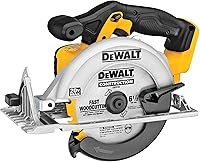
DeWalt DCS571B: compact cordless work
Choose the DeWalt for wood projects where cordless movement and a compact blade suit the job. Its bevel gear design allows cuts through 2x material at 90 degrees, and the removable auxiliary handle gives you another point of control.
It uses the DeWalt 20V MAX battery system and comes as a tool-only model, so account for a compatible battery and charger. Skip it if your main need is greater cutting depth for thicker stock.
Its electronic blade brake stops the blade quickly, but always wait for a complete stop before setting the saw down. Remove the battery before reaching near the blade, even after the brake has acted.
Makita 5007Mg: framing and panel work
Choose the Makita for framing lumber and sheet goods when a corded tool suits your workspace. It has a 15-amp motor, a 2-1/2 in cutting capacity at 90 degrees, and bevel adjustment up to 56 degrees.
The built-in lights illuminate the cut line, while a dust blower helps keep it visible. These features suit work where following a marked line matters, but they cannot correct poor support or a mismatched blade.
Skip it if you mainly need compact cordless movement for short cuts. Route its cord clear of the cutting path and keep it from catching on the workpiece as you advance.
Skil 5080-01: occasional home projects
Choose the Skil for shelving, trim, and other occasional wood projects near an outlet. Its 13-amp motor and bevel adjustment up to 51 degrees cover straight and angled cuts, with a positive stop at 45 degrees.
The included 18-tooth carbide blade suits rougher wood cutting better than finish work that needs a very clean edge. Choose a compatible blade intended for finer cuts when the exposed edge matters.
Skip it if battery-powered movement is essential. For a broader comparison of compact tools and full-size models, see how to choose a circular saw.
What happens if a circular saw blade is backward?
A backward blade can cut poorly, create heat, and require excessive pushing. Stop if the saw struggles, burns the wood, or produces an unusual cut instead of forcing it forward.
Disconnect power and check direction first. If the blade is correctly oriented, inspect for damage, dull teeth, pitch buildup, or a blade unsuited to the material.
Binding can also come from a workpiece closing around the blade. Support the material so the cut stays open, and stop immediately if the blade binds.
Straight cuts need good guidance as well as a suitable blade. Our guide to cutting straight with a circular saw explains line following and guide setup.
What setup and care mistakes should you avoid?
Avoid excess blade depth, poor support, and forced feeding. These problems can spoil a cut even when the blade faces the correct way.
Set the depth as your manual directs, generally with only a small amount of tooth projecting below the workpiece. Check beneath the cut for supports, cords, and anything else the blade could strike.
Clamp the work securely and keep hands out of the cutting path. Let the blade reach operating speed before entering the material, then feed steadily without twisting the saw.
Keep pitch and resin off the blade with a cleaner approved for that blade. Disconnect power before cleaning, avoid sharp edges, and inspect for cracks or missing tips.
Never bypass a sticking lower guard or tie it open for routine cuts. Correct the cause before using the saw, and store spare blades so their teeth cannot strike each other.
Which way should a circular saw blade go? Make the final check
Decide which way a circular saw blade goes by matching the rotation arrows, then confirm fit, fastening, and guard movement. If any part remains unclear, identify the exact saw and blade before proceeding.
Keep your current saw if a correct blade change solves the problem. Choose the DeWalt for compact cordless work, the Makita for framing and panels, or the Skil for occasional home cutting.
Follow our blade-change guide when you're ready to fit the blade.
Frequently asked questions
Which way should the teeth face on a circular saw blade?
The teeth’s cutting edges must point in the direction of rotation specified for your saw. Match the blade arrow to the saw’s rotation arrow, then confirm the position in your manual.
Don’t rely on which side has the label or copy the blade position on a different saw.
Do circular saw blades spin clockwise or counterclockwise?
Clockwise or counterclockwise depends on which side of the blade you’re viewing. The same rotation looks opposite from the other side, so use the rotation arrows on the tool and blade instead of a general direction rule.
Your saw manual identifies the correct blade orientation for that model.
How can I tell if a circular saw blade is installed backward?
With power disconnected, compare the blade’s rotation arrow with the arrow on the saw and check the orientation against your manual. Arrows pointing in opposite directions indicate a backward blade.
Don’t run the saw to find out; correct the installation according to the manual before reconnecting power.
Can I use a circular saw blade with no direction arrow?
Use it only if you can confirm its correct orientation and compatibility from the blade instructions and your saw manual. Don’t guess from tooth shape alone.
If you can’t confirm the direction or fit, choose a clearly marked compatible blade before proceeding with installation or cutting.