DeWalt FLEXVOLT DCS578B Circular Saw Review: Worth It? (November 2026)
The DeWalt DCS578 suits regular cordless wood cutting, especially if you already use compatible FLEXVOLT batteries. Choose the DCS578B for its full-size cutting capacity; compare the DCS590B first if you want to stay with 20V MAX tools.
On this page (8 sections)
- What does the DeWalt DCS578B offer?
- Which alternative fits your battery setup and cutting style?
- How much cutting capacity do you actually need?
- What battery and charger plan makes sense?
- How should you set up the DCS578B for a clean cut?
- Which mistakes waste the DCS578B's capacity?
- How should you care for the saw between projects?
- Should you buy the DeWalt DCS578?
The DeWalt DCS578 is a good fit for regular cordless wood cutting, especially when you already have compatible FLEXVOLT batteries. Its full-size capacity suits buyers cutting boards and sheet goods who want room for deeper cuts and angled work.
The DCS578B is the tool-only version, so the battery and charger are separate buys. Before choosing it, compare your actual cuts, battery setup and preferred handle layout with the alternatives below.
What does the DeWalt DCS578B offer?
The DCS578B offers a 7-1/4 in blade and 2-9/16 in maximum cutting depth at 90 degrees. Its bevel adjustment reaches 57 degrees, with stops at 22.5 and 45 degrees.
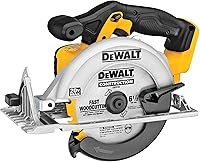
DeWalt DCS578B FLEXVOLT Circular Saw: Best for FLEXVOLT woodworkers

- 7-1/4 in blade
- 2-9/16 in cut depth at 90 degrees
- 57-degree bevel capacity
- Electric brake and integrated LED
A full-size cordless wood saw for buyers who want FLEXVOLT power and room for deeper or angled cuts. It makes the most sense when compatible batteries already fit your tool setup.
Pros
- Deep maximum cut at 90 degrees
- Bevel stops at common angles
- Electric brake
- Integrated LED and rafter hook
Cons
- Battery and charger sold separately
- A full-size saw may be unnecessary for occasional thin-stock cuts
Its brushless motor has a no-load speed of 5,800 rpm. DeWalt claims up to 47% more power than the DCS575, which is a comparison with that specific saw, not a ranking against every cordless model.
The electric brake helps stop blade rotation after trigger release. You still need to wait for a complete stop before moving the saw away from the work or setting it down.
An integrated LED illuminates the cut area, while the rafter hook provides a place to hang the saw between tasks. Neither replaces a clear pencil line, good work lighting or secure storage.
Who should buy the DeWalt DCS578?
Buy it if you regularly cut wood away from an outlet and want full-size capacity within a FLEXVOLT setup. It also suits someone starting a cordless tool collection who has deliberately chosen that platform.
Skip it if most of your work involves short cuts in thin stock and you find a full-size saw awkward to position. Our cordless circular saw guide explains how to choose around the work you actually do.
It is also worth skipping if you expect more motor power to fix wandering cuts or chipped edges. Blade choice, work support and a guide often matter more to those problems.
Which alternative fits your battery setup and cutting style?
The DCS590B suits 20V MAX users, the Milwaukee suits M18 users, and the DCS577B suits rear-handle users. Compare those needs before adding another battery system just to gain a particular saw.
| Saw | Platform | Maximum cut depth at 90 degrees | Bevel capacity | Main reason to choose it |
|---|---|---|---|---|
| DeWalt DCS578B FLEXVOLT Circular Saw | FLEXVOLT 60V MAX | 2-9/16 in | 57 degrees | Full-size wood cutting within FLEXVOLT |
| DeWalt DCS590B 20V XR Circular Saw | 20V MAX XR | 2-9/16 in | 57 degrees | Staying with compatible 20V MAX tools |
| Milwaukee M18 7-1/4 Inch Circular Saw | M18 cordless | Confirm before capacity-critical work | Confirm before capacity-critical work | Staying with compatible M18 tools |
| DeWalt DCS577B FLEXVOLT Framing Saw | FLEXVOLT 60V MAX | 2-7/16 in | 53 degrees | Rear handle and blade-left sightline |
DCS590B: choose it to keep your tools on 20V MAX
The DCS590B is the closest alternative here for buyers who want the same cutting envelope without moving to a FLEXVOLT saw. It has a top handle, a blade to the right of the motor and an electric brake.
DeWalt advertises up to 368 cuts per charge, but your material, blade and battery setup determine actual runtime. Don't use that number to plan a full workday without allowing for charging.
Skip this model if your main reason for changing saws is a rear-handle layout. For the closer platform decision, read our DCS578B vs DCS590B comparison.
Milwaukee M18: choose it for an existing M18 setup
The Milwaukee 2631-20 gives M18 users a brushless saw with magnesium upper and lower guards. Its integrated dust port is worth considering if you want to plan dust collection around the saw.
Check the required hose connection before assuming your current equipment will fit. A dust port also doesn't remove the need for suitable respiratory protection and ventilation.
Choose it when keeping a compatible M18 battery setup matters more than matching the DeWalt brand. Skip it if an exact depth or bevel requirement drives the job until you have confirmed those limits with Milwaukee.
DCS577B: choose it for the rear handle
The DCS577B puts the blade to the left of the motor and the handle at the rear. That layout is its main reason to choose it over the DCS578B.
A dust blower clears the sightline, and onboard wrench storage keeps the blade-change tool with the saw. Its body measures 18 in long, so account for storage space and room to position it at the start of a cut.
Skip it if you prefer a shorter body or need the larger cutting envelope shown above. For a separate DeWalt option, our DCS391B review covers another model you may be considering.
How much cutting capacity do you actually need?
Choose capacity by stock thickness and cut angle together. A maximum depth at a square setting does not describe what the saw can reach when tilted.
Measure the material rather than relying only on its nominal lumber size. If your cut is near the saw's limit, check the required blade position and available depth before committing to that model.
Extra depth is useful when it turns a job into one controlled pass. It provides little benefit if all your planned cuts are comfortably within the capacity of a saw that better fits your battery setup.
For bevel work, angle stops provide convenient reference points, but close-fitting joints still need a checked setup. Make a sample cut on scrap of the same thickness before cutting pieces that must meet cleanly.
Long plywood cuts create a different buying question: how will you keep the saw straight? Compare a clamped straightedge with other options in our circular saw guide and guide rail roundup.
What battery and charger plan makes sense?
Buy the DCS578B only with a confirmed compatible FLEXVOLT battery and charger plan. A tool-only saw is useful for expanding an existing setup, but incomplete for someone starting from nothing.
Check exact battery and charger models rather than relying on color, brand or a similar-looking connection. Ordinary 20V MAX batteries should not be assumed suitable for this 60V MAX saw.
For occasional projects, allow time to recharge between work sessions. For repeated cuts away from a charging point, think through how you will keep charged batteries available.
The saw's stated weight is 8.2 lb, but that figure does not guarantee the weight of your chosen battery-equipped setup. Consider carrying, lifting and positioning the complete tool, especially if you move between work areas often.
If battery convenience is not central to your work, revisit the power-source decision before buying. Our complete circular saw buying guide helps match the tool type to your workspace and projects.
How should you set up the DCS578B for a clean cut?
Start with the correct blade, stable support and a clear blade path. Good setup reduces binding, wandering and damage to the edge of your workpiece.
Match the blade to the cut
Use a wood-cutting blade suited to the material and finish you need. A blade meant for quick framing cuts serves a different purpose from one selected for a cleaner plywood edge.
Check diameter, arbor fit and speed requirements against the manual. The saw's wood-cutting role does not make it suitable for another material simply because a different blade can be fitted.
Remove the battery before blade changes or adjustments. Our guide to changing a circular saw blade covers the basic sequence alongside the instructions for your saw.
Support the work without trapping the blade
Clamp the workpiece and arrange support so the cut cannot close and pinch the blade. Keep the blade path clear of benches, clamps, cords and anything beneath the material.
For sheet goods, support the panel so it stays stable as the cut progresses. Plan how the offcut will behave at the end rather than reaching for it while the blade is moving.
Set depth and check the guide offset
Set the blade to project only as far beneath the work as the manual directs. Leaving it at maximum depth for every job exposes more blade than needed.
If you use a straightedge, measure the offset between the blade and the edge of the shoe. Confirm the guide position with the actual blade and bevel setting before cutting finished material.
Our guide to cutting straight with a circular saw explains how to position and secure the guide.
Plan the full cutting motion
With the battery removed, check that the shoe can travel the full route without hitting a clamp. Position yourself so you can maintain the recommended grip through the cut without reaching across the blade path.
Wear eye and hearing protection, and manage wood dust with suitable extraction and respiratory protection. Keep loose clothing and other people clear of the cutting area.
Follow DeWalt's starting procedure, let the blade reach speed before entering the material, and feed steadily without forcing it. Our circular saw use guide covers the broader cutting sequence.
Which mistakes waste the DCS578B's capacity?
The biggest mistakes are buying for headline power and neglecting the cut setup. More power cannot compensate for a dull blade, shifting workpiece or crooked guide.
- Forcing the feed. If cutting becomes harder, stop and check the blade, support and battery condition rather than pushing harder.
- Correcting a wandering cut by twisting the saw. Stop safely, wait for the blade to stop and reset the approach.
- Assuming a bevel stop guarantees a perfect joint. Check a sample cut before working on matching parts.
- Treating the LED as the cut line. Mark the work clearly and use the correct shoe reference for the blade setting.
- Relying on the brake before setting the saw down. Verify that the blade has stopped and the guard has returned.
- Buying another battery platform for occasional work. Compare the complete setup with a saw that fits the compatible tools you already use.
A repeated problem usually calls for checking the setup before changing the saw. Burn marks, difficult feeding and rough edges can point to blade or technique issues rather than insufficient motor power.
How should you care for the saw between projects?
Keep the blade, guard movement and adjustment points clean and secure. Remove the battery before inspection or cleaning.
Clear accumulated sawdust using the method allowed in the manual. Inspect the lower guard for free movement and proper return; stop using the saw if the guard sticks or fails to close.
Check the blade for damage and buildup when cuts become harder or rougher. Clean or replace it as appropriate rather than forcing it through the next board.
Inspect the shoe for damage after a drop, and check depth and bevel locks before use. A loose adjustment can spoil a cut even when the angle was set correctly.
Store the saw dry and secure, with the blade protected and the battery handled according to its instructions. Use the rafter hook only on a suitable support where the saw cannot be knocked loose.
Should you buy the DeWalt DCS578?
Choose the DeWalt DCS578 for regular cordless wood cutting within a FLEXVOLT setup. Its capacity is useful when your actual stock and angles call for it, and the separate battery and charger fit your plans.
Choose the DCS590B if keeping compatible 20V MAX tools together is your priority. Stay with the Milwaukee option if M18 already serves your work, or choose the DCS577B when the rear-handle layout is the deciding factor.
Before ordering, write down your thickest cut, steepest bevel and exact battery model. If none of those points clearly favors the DCS578B, compare the best cordless circular saws around the setup you need.
Frequently asked questions
Is the DeWalt DCS578B a 7-1/4 in saw?
Yes, the DeWalt DCS578B uses a 7-1/4 in circular saw blade. Choose a blade with the correct arbor fit, speed rating and tooth design for your cut, following the manual; a framing blade and a fine-finish blade serve different jobs even when their diameter matches.
Does the DCS578B come with a battery and charger?
No, the DCS578B is a tool-only saw, with the battery and charger sold separately; plan for a compatible FLEXVOLT battery and suitable charger before buying. If you already have DeWalt cordless tools, check the exact battery model rather than assuming the shared brand guarantees compatibility.
What is the DCS578B bevel capacity?
The DCS578B bevels up to 57 degrees, with stops at 22.5 and 45 degrees. Available cutting depth decreases as the blade tilts, so measure the workpiece and check the required angle together; for close-fitting joints, verify the setting on scrap before cutting your finished pieces.
How does the DCS578B compare with the DCS590B?
Choose between them mainly by battery platform: the DCS578B uses FLEXVOLT 60V MAX, while the DCS590B uses 20V MAX XR. Both offer the same maximum square-cut depth and bevel range; that makes battery compatibility and your preferred tool setup more useful deciding factors than capacity alone.