DeWalt DCS391B 20V MAX Circular Saw Review: Worth It? (November 2026)
The DeWalt DCS391 suits general wood cutting, especially if you already own compatible 20V MAX batteries. Choose the DCS391B for its magnesium shoe and bevel adjustment, after checking that its cutting capacity fits your projects; the battery and charger are sold separately.
On this page (7 sections)
- What does the DeWalt DCS391 offer for DIY woodwork?
- What should you check before buying the bare tool?
- Which smaller cordless saw suits your projects?
- How should you set up the DCS391B for a clean cut?
- Which cutting mistakes should you avoid?
- How do you care for the saw between projects?
- Should you buy the DeWalt DCS391?
The DeWalt DCS391 is a sensible choice for general wood cutting, especially if you already use compatible DeWalt 20V MAX batteries. The DCS391B suits buyers who want a main cordless saw for varied DIY projects rather than choosing mainly for a compact format.
Its magnesium shoe and rubber overmolded grip are useful reasons to consider it, but your usual materials should decide the purchase. Check the required cutting depth at both straight and bevel settings before committing.
If compact size is your priority, compare the DeWalt DCS571B review. For a wider choice of battery systems and saw formats, see our best cordless circular saws.
What does the DeWalt DCS391 offer for DIY woodwork?
The DCS391B combines a 6-1/2 in blade and 0–50° bevel adjustment with cordless power. That makes it worth considering for straight cuts and angled work, provided its cutting capacity matches your stock.
DeWalt DCS391B 20V Circular Saw: Best for general DIY woodwork
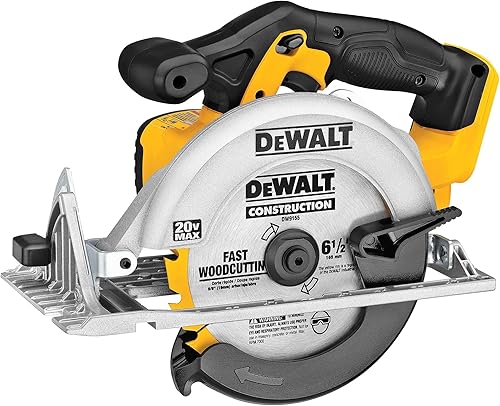
- 6-1/2 in blade
- 0–50° bevel capacity
- Magnesium shoe
- Battery and charger sold separately
A practical choice for general woodwork if you already have compatible DeWalt batteries. Its magnesium shoe and rubber overmolded grip support the case for choosing it as your main cordless saw.
Pros
- Magnesium shoe
- Rubber overmolded grip
- Bevel adjustment for angled cuts
Cons
- Battery and charger sold separately
- Less compact blade format than the DCS571B
The shoe is the flat base that rides on the workpiece. DeWalt describes its magnesium construction as strong and lightweight, with durability intended to support long-term cut accuracy.
A sound shoe matters because it gives you a stable reference against the board or a straightedge. Clean material, firm support and a correctly aligned guide still do much of the work of keeping a cut straight.
The rubber overmolded grip gives you another point to assess before buying. You should be able to reach the controls and maintain a secure working grip without stretching your hand into an awkward position.
Is the DeWalt DCS391 a good fit for your work?
Choose the DCS391 for varied wood projects on an existing battery system. It makes the strongest buying case when you need a general-purpose saw and already have the compatible batteries and charger.
Skip it if compact size is your main goal or your planned cuts exceed its capacity. A larger blade than the alternatives here doesn't automatically mean it can finish every cut in one pass.
The DeWalt DCS571B 4-1/2 Inch Circular Saw offers a compact alternative. The DCS578B review gives you another model to compare if these choices don't fit your work.
What should you check before buying the bare tool?
Check battery compatibility, cutting capacity and blade requirements before buying. The DCS391B comes without a battery or charger, so first-time cordless buyers need to plan for a complete working setup.
Start with the exact batteries you own, not just the brand printed on them. The DeWalt models here include separate 20V MAX and 12V MAX platforms, so don't assume every yellow tool shares your existing packs.
Next, write down your thickest regular material and the angles you'll cut. A saw that handles your straight cuts may not have enough depth when tilted for a bevel.
Also consider how you work through a project. One charged battery may fit occasional short jobs, while repeated cutting calls for a charging plan and access to a compatible spare.
If this is your first saw, our circular saw buying guide explains the main format choices. For accurate guide placement, read how to cut straight with a circular saw.
Which smaller cordless saw suits your projects?
Choose a smaller alternative when its format or your existing batteries better fit the job. Compare usable cutting depth and control features before treating any compact saw as a replacement for a general-purpose model.
| Saw | Blade size | Platform | Bevel capability |
|---|---|---|---|
| DeWalt DCS391B 20V Circular Saw | 6-1/2 in | 20V MAX | 0–50° |
| DeWalt DCS571B 4-1/2 Inch Circular Saw | 4-1/2 in | 20V MAX | 45° cuts in 1x lumber |
| Ryobi ONE+ P505 5-1/2 Inch Circular Saw | 5-1/2 in | Ryobi 18V ONE+ | Up to 50° |
| DeWalt DCS512B 12V 5-3/8 Inch Circular Saw | 5-3/8 in | 12V MAX | 0–50° |
DCS571B: choose it for compact work on 20V MAX
The DCS571B suits buyers who want a compact saw while staying with compatible DeWalt batteries. Its bevel gear design allows straight cuts through 2x material and 45° cuts through 1x dimensional lumber.
Its brushless motor, electronic blade brake and dust port give it a distinct feature set. The removable auxiliary handle provides an additional point of control, while the included rip fence can help guide suitable edge-parallel cuts.
Pick it when those cutting limits cover your work and the compact shape matters. Skip it if you regularly need more depth, especially at an angle.
A blade brake doesn't replace safe handling. Keep the saw supported and wait for the blade to stop fully before setting it down.
Ryobi P505: choose it to use existing ONE+ batteries
The P505 suits household woodcutting when you already own compatible Ryobi 18V ONE+ batteries. Staying with that system avoids adding another charging setup just to get a saw.
Its extra side handle provides a second grip, and the transparent lower guard helps with visibility around the cutting area. Rubber overmold on the handles is another useful control feature.
Choose it for platform convenience after checking its capacity against your projects. Skip it if your batteries are all DeWalt and you have no other reason to start a Ryobi tool set.
DCS512B: choose it for an existing 12V MAX setup
The DCS512B suits buyers who want a compact brushless saw within DeWalt’s 12V MAX system. Its tool-free bevel lever simplifies angle changes, and its rafter hook provides a storage option between cuts.
Its maximum cutting depth is 1-3/4 in at 90° and 1-1/4 in at 45°. Those limits are the key check for anyone planning to cut thicker stock or make frequent bevel cuts.
Choose it when those depths cover your materials and you already use the platform. Skip it if you're expecting to share the batteries used by the 20V MAX saws here.
How should you set up the DCS391B for a clean cut?
Set up a supported workpiece, suitable blade and locked adjustments before connecting the battery. A careful setup helps prevent wandering cuts, torn edges and binding.
Match the blade to the material and finish
Use a blade that meets the saw manual’s requirements for diameter, arbor and speed. Then choose its tooth pattern for the material and the kind of cut you're making.
For wood, blades intended for fast rough cutting and those intended for a cleaner finish serve different needs. Don't try to fix a poor blade match by pushing the saw harder.
Install the blade in the direction shown by the saw and blade markings. Our guide to changing a circular saw blade explains the process, with the model’s manual taking priority for fastening details.
Set depth and bevel before starting
Remove the battery before adjusting depth or angle. Set the blade to project only slightly below the material, following the clearance specified in the manual, and secure each adjustment.
For angled cuts, confirm that the blade will reach through the stock at that setting. Make a practice cut on scrap and check the result with the measuring tool your joint requires.
Support the material and allow for the kerf
Secure the work so it won't slide, and arrange the supports so the cut won't close around the blade. Keep the blade’s path clear of clamps, supports and the surface below.
Mark which side of the line is waste. The kerf is the strip of material removed by the blade, so cutting down the center of a finished-size mark can leave the part too short.
A straightedge must account for the distance between the blade and the shoe’s edge. Measure that offset on your saw rather than borrowing a distance from another model.
Which cutting mistakes should you avoid?
Avoid forcing the feed, twisting the saw and cutting poorly supported stock. These habits can spoil the cut and increase the chance of binding or kickback.
Wear eye and hearing protection, and use suitable dust protection for the material. Keep both hands clear of the cutting path and use the grip positions specified in the manual.
Let the blade reach operating speed before entering the wood. Keep the shoe supported on the work and move at a steady rate that lets the blade cut without being forced.
If progress slows sharply, stop and investigate after the blade stops and the battery is removed. Check the blade’s condition, workpiece support and whether the cut is pinching closed.
Don't twist the running saw sideways to rescue a wandering cut. Stop safely, then reset the work or guide before continuing.
Never reach beneath the board or hold a short offcut by hand near the blade. Clamp small work securely and keep your body out of the likely kickback path.
For the full cutting sequence, read how to use a circular saw before your first project.
How do you care for the saw between projects?
Keep the shoe, guard and blade clean, and check their condition before each use. Remove the battery before cleaning, inspection or maintenance.
Clear loose sawdust with a brush, paying attention to the shoe and adjustment areas. Follow the manual’s cleaning method and keep liquid out of the tool and battery contacts.
Check that the lower guard moves freely and returns as intended. Stop using the saw if the guard sticks, the blade is damaged or an adjustment won't lock securely.
Inspect the shoe after a drop or hard impact. A damaged base can change how the saw follows a guide, even when the cut line looks correctly aligned.
Store the tool dry with the blade protected, and follow the battery instructions for storage and charging. Replace a worn blade rather than compensating with extra feed pressure.
Should you buy the DeWalt DCS391?
Buy the DeWalt DCS391 for general woodwork when its cutting capacity fits your projects and compatible 20V MAX batteries already support your tool set. Before ordering, settle the blade requirements and charging setup you'll need for the first job.
Choose the DCS571B when compact handling and its added control features matter more. Stay with the P505 if compatible Ryobi batteries make it the simpler household choice, or choose the DCS512B for suitable work within a 12V MAX setup.
If you still haven't settled on a saw format, use our circular saw buying guide to match the tool to your materials and workspace.
Frequently asked questions
Does the DeWalt DCS391B come with a battery?
No, the DCS391B comes without a battery or charger; it uses compatible DeWalt 20V MAX batteries, so include both items in your setup if you don't already have them. Check the exact battery and charger compatibility before buying, rather than choosing by brand name alone.
What size blade does the DeWalt DCS391B use?
The DCS391B uses a 6-1/2 in circular saw blade; when choosing a replacement, match the manual’s blade diameter, arbor requirements and speed rating, then choose teeth suited to your material and desired finish. Remove the battery before any blade change and follow the manual’s fastening instructions.
Can the DCS391B make bevel cuts?
Yes, the DCS391B adjusts from 0° to 50° for bevel cuts; cutting depth changes as you tilt a circular saw, so check capacity at your intended angle before starting. Remove the battery for adjustments, lock the bevel setting firmly and make a practice cut in scrap.
How does the DCS391B compare with the DCS571B?
Choose the DCS391B for general woodwork, or the DCS571B when a compact format fits your projects better; both use the 20V MAX platform, while the DCS571B adds a brushless motor, electronic blade brake and dust port. Check cutting capacity at the angle you need before choosing either saw.


