DeWalt DCS571 Review: Worth It? (November 2026)
The DeWalt DCS571 suits DIYers who want a compact saw for wood projects and already use compatible 20V MAX batteries. Choose it for square cuts through 2x material and 45° bevels in 1x lumber; choose another saw if your regular cuts need more depth.
On this page (9 sections)
- Who should buy the DeWalt DCS571?
- What do the DCS571's features add to everyday use?
- Where does the DCS571's cutting capacity become a limit?
- Which alternative should you choose instead?
- How should you set up the DCS571 before a cut?
- How can you get straighter, cleaner cuts?
- Which blade should you use, and how should you care for it?
- What dust-control mistakes should you avoid?
- Should you choose the DeWalt DCS571 or another saw?
The DeWalt DCS571 is a good fit for compact wood projects if you already use DeWalt 20V MAX batteries and its cutting capacity covers your work. It handles square cuts through 2x material and 45° bevel cuts in 1x dimensional lumber.
That makes it worth considering for shelf parts, panel trimming and small project pieces within those limits. Choose by the cuts you need to finish, not by the assumption that a smaller saw will handle every job more easily.
Who should buy the DeWalt DCS571?
Buy the DCS571 if you want a compact project saw on the 20V MAX platform and can work within its depth limits. It also makes sense as a second saw when a larger tool already covers your deeper cuts.
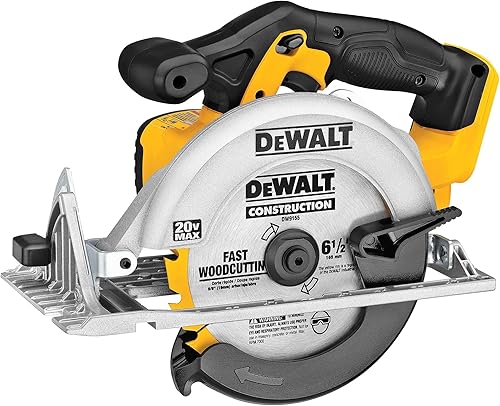
DeWalt DCS571B 4-1/2 Inch Circular Saw: Best for compact wood projects

- 4-1/2 in blade
- Brushless motor
- Electronic blade brake
- Dust port
A compact choice for wood projects within its cutting capacity, especially if you already use DeWalt 20V MAX batteries. Includes a removable auxiliary handle, rip fence and dust port adaptor.
Pros
- Cuts 2x material at 90°
- Electronic blade brake
- Includes blade key, rip fence and dust port adaptor
Cons
- 45° cutting application is 1x lumber
- Battery and charger sold separately
When does the DeWalt DCS571 make sense?
The DCS571 suits buyers who regularly trim wood to length or width and value a compact tool format. Its removable auxiliary handle gives you another point of control, while the included rip fence helps guide suitable edge-following cuts.
It's a sensible match for a DIYer cutting parts at a supported work surface. Small workpieces still need firm support and clamping; a compact saw doesn't make it safe to hold a piece in your free hand.
Buyers with existing compatible batteries have a clear reason to choose this model. Those starting from scratch should compare the complete saw, battery and charger setup with the best cordless circular saws.
Who should skip it?
Skip the DCS571 if your routine work calls for deeper bevel cuts, thick stock or joints that need more reach. A saw that nearly reaches through your material is the wrong choice for a repeat task.
Also look elsewhere if you expect the saw alone to deliver furniture-ready edges on long panels. A suitable blade, firm support and an accurate guide matter as much as the tool's size.
If you're choosing your first saw, read about where mini circular saws fit before committing to a compact model. Make sure the tool covers your next few projects, not just the smallest cut on today's list.
What do the DCS571's features add to everyday use?
The most useful features are its electronic blade brake, dust connection and control options. They address stopping, cleanup and handling, which affect how you set up and finish each cut.
The saw uses a 4-1/2 in blade and a brushless motor. DeWalt says it can cut up to 369 linear feet of 3/4 in OSB with a DCB205 battery, but that figure applies to that battery and material.
Use that claim as context for sheet-material work, not as a promise for every project. Blade condition, material and the way you feed a cordless saw can all affect how much work a charge completes.
The blade brake stops the blade quickly after release. Keep the saw supported until the blade stops, and confirm the guard has closed before setting it down.
The long finger trigger allows a closer grip for suitable applications, according to DeWalt. Follow the approved hand positions in the manual rather than moving your hand toward the blade for a better view.
Onboard key storage helps keep the blade-change tool with the saw. The hang hook adds a place to park it between tasks, provided the support is secure and the saw cannot fall.
Where does the DCS571's cutting capacity become a limit?
Bevel cuts need a separate capacity check because tilting a circular saw reduces its available cutting depth. Being able to make a square cut through a board doesn't mean the same board can be cut at an angle.
Nominal lumber names can also mislead a new buyer. Measure the actual thickness of the piece, then compare it with the saw's capacity at the angle you plan to use.
Don't solve a depth shortfall by forcing the saw or removing its guard. For repeat work, choose a tool that can complete the required cut using its normal setup.
A second pass from the opposite face can leave a step if the cuts don't meet. That is a poor workaround for visible parts where alignment matters.
Cutting depth also isn't permission to cut any material that fits beneath the shoe. Use only materials, blades and applications allowed by the saw's manual.
Which alternative should you choose instead?
Choose an alternative when battery compatibility or required cutting capacity gives it a clear advantage. A larger blade is a reason to investigate a saw, not proof that it handles every cut the DCS571 cannot.
| Product | Best for | Blade | Bevel | Battery platform | Our score |
|---|---|---|---|---|---|
| DeWalt DCS391B 20V Circular Saw | general DIY projects | 6-1/2 in | 0–50° | 20V MAX | 8.8 |
| DeWalt DCS571B 4-1/2 Inch Circular Saw | compact wood projects | 4-1/2 in | 20V MAX | 8.6 | |
| DeWalt DCS512B 12V 5-3/8 Inch Circular Saw | DeWalt 12V owners | 5-3/8 in | 12V MAX | 7.7 | |
| Milwaukee M12 Fuel 5-3/8 Inch Circular Saw | Milwaukee M12 users | 5-3/8 in | M12 | 7.6 |
DeWalt DCS391B: for varied DIY work
The DCS391B is the first alternative to compare if you want a larger-blade saw while keeping DeWalt 20V MAX batteries. It uses a 6-1/2 in blade, has a magnesium shoe and offers bevel adjustment from 0–50°.
That combination makes it worth a closer look for a buyer selecting one saw for several kinds of wood projects. Check its actual cut depth at your intended angle before treating it as the answer to a capacity problem.
Skip it if your work already fits the DCS571 and you specifically want the ATOMIC model's format and features. The DeWalt DCS391B review helps you weigh that choice in more detail.
DeWalt DCS512B: for existing 12V MAX owners
Choose the DCS512B if you already use DeWalt 12V MAX batteries and its cutting depths cover your work. It uses a 5-3/8 in blade, with maximum depths of 1-3/4 in at 90° and 1-1/4 in at 45°.
Its tool-free bevel lever adjusts through 0–50°, and a built-in rafter hook provides a storage option between cuts. The brushless motor and compact design make it relevant to buyers seeking a smaller cordless saw.
Skip it if your reason for choosing DeWalt is an existing collection of 20V MAX batteries. The shared brand name doesn't make the two battery platforms interchangeable.
Milwaukee M12 Fuel: for staying with M12
Choose the Milwaukee if you already have M12 batteries and a charger. This bare tool uses a 5-3/8 in blade and a POWERSTATE brushless motor.
Milwaukee's REDLINK PLUS system provides overload protection through communication between the tool, battery and charger. That protection doesn't replace a sharp blade or steady feed pressure.
Skip it if buying it would add another battery system without solving a specific cutting need. Confirm its cut depths before choosing it for work beyond the DCS571's reach.
For a broader DeWalt comparison, the DCS578B review covers another option within the brand.
How should you set up the DCS571 before a cut?
Start with stable support, a secure workpiece and the battery removed while you make adjustments. A sound setup keeps the saw's base supported and prevents the cut from closing on the blade.
- Check the blade and guard. Look for damaged teeth, cracks or a guard that doesn't return freely, and correct any problem before use.
- Set the depth. Follow the manual's guidance for blade projection beneath the material rather than leaving the saw at full depth for every cut.
- Set and secure the bevel. Confirm the angle and tighten the adjustment before reconnecting the battery.
- Arrange the supports. Keep the blade path clear of the bench, clamps and anything beneath the work.
- Check the cutting route. Plan where the saw, battery and dust hose will travel from start to finish.
Support sheet material so neither side sags into the cut and pinches the blade. For narrow pieces, use a secure workholding method that keeps your hands away from the cutting path.
Make a practice cut in scrap of the same thickness when the finished size matters. It helps confirm the guide position and which side of the marked line the blade removes.
If you're new to powered saws, read how to use a circular saw before beginning. Wear suitable eye and hearing protection, and follow the dust-protection guidance for the material.
How can you get straighter, cleaner cuts?
Use a secure guide, a suitable sharp blade and steady feed pressure. Trying to steer a drifting saw back toward the line can twist the blade in the cut.
Use the included rip fence when you have a straight reference edge and the cut suits the fence. A rough or curved edge transfers its errors to the new cut.
For longer cuts, use a suitable straightedge clamped clear of the saw and guard. Measure the offset between the blade and the edge of the shoe instead of placing the guide directly on your cut line.
Keep the shoe flat throughout the cut and let the blade reach operating speed before entering the wood. Support the saw as it exits so the base doesn't tip and spoil the edge.
Don't pull a moving blade backward through the cut. If you need to stop and reposition, release the trigger, wait for the blade to stop and follow the manual's restart steps.
For guide placement and line control, see how to cut straight with a circular saw.
Which blade should you use, and how should you care for it?
Choose a compatible blade made for your material and cut, rather than choosing by diameter alone. The DCS571 includes a wood-cutting blade, a blade-change key and a dust port adaptor.
Check the required arbor fit, speed suitability and blade type in the manual. A blade intended for fast rough cuts may leave a different edge from one intended for cleaner finish work.
Remove the battery before changing or inspecting the blade. Follow the manual for blade direction, hardware order and tightening, then confirm that the guard moves freely.
The guide to changing a circular saw blade explains the general process. Use the DCS571 instructions for the exact steps and approved parts.
Clear dust from the shoe, guard area and vents as the manual directs. Clean buildup from blades only with a suitable method, and replace damaged blades rather than trying to keep using them.
If cutting starts to require much more force, stop and check the blade, depth setting and work support. Pushing harder can hide a dull edge or a pinching cut without fixing either problem.
What dust-control mistakes should you avoid?
Connect suitable extraction and keep the hose clear of the saw's travel. A dust port helps manage debris, but the hose can interfere with control if it catches a bench edge or pulls against the tool.
Check that the adaptor and hose stay secure before starting. Leave enough slack to finish the cut without dragging the extractor or lifting the shoe.
Don't assume visible dust collection removes the need for respiratory protection. Follow the saw, extractor and material guidance, and clean the workspace without blowing settled dust into the air.
After use, remove the battery before clearing a blockage or inspecting the port. Store the saw where the blade and guard are protected from knocks.
Should you choose the DeWalt DCS571 or another saw?
Choose the DeWalt DCS571 for compact wood projects within its capacity, especially when compatible batteries are already on your shelf. Before buying, write down the thickest square cut and deepest bevel cut you expect to make.
Compare the DCS391B if you want a larger-blade 20V MAX option for varied work. Choose the DCS512B or Milwaukee M12 Fuel when your existing battery system makes either a better fit and its capacity meets those cuts.
If the DCS571 would need a workaround for a task you repeat often, choose another saw now. Use the circular saw buying guide to match your project list to blade size, cutting depth and guide needs.
Frequently asked questions
What can the DeWalt DCS571 cut?
The DeWalt DCS571 cuts 2x material at 90° and 1x dimensional lumber at 45°, making it a fit for wood projects within those limits. Measure your stock's actual thickness and check the manual before cutting, especially when changing the bevel angle or working with a different material.
Does the DeWalt DCS571 include a battery?
The DCS571B is a tool-only model, so you need a compatible DeWalt 20V MAX battery and charger. If you already have those, the bare tool can fit your existing setup; if you don't, include both in your buying decision rather than comparing the saw bodies alone.
Does the DeWalt DCS571 have a dust port?
The DCS571 has an onboard dust port and includes a dust port adaptor for connecting suitable dust collection equipment. Check the connection before starting, route the hose away from the cutting path, and use the eye, hearing and respiratory protection required for your material and work.
How does the DCS571 compare with a regular circular saw?
The DCS571 uses a smaller blade than the DCS391B and focuses on compact cutting within a narrower set of stated applications. Choose between them by checking material thickness, required bevel cuts and battery compatibility; blade diameter alone doesn't guarantee usable cutting depth or which saw will suit your projects.


