9 Best Track Saws (November 2026)
The best best track saws include the Makita SP6000J Plunge Saw for workshop panel projects, the WEN CT1065 Track Saw for occasional plywood projects, and the Makita XPS01Z Plunge Saw for existing LXT users.
On this page (8 sections)
- How we chose the best track saws
- Compare the best track saws
- Best track saws by buyer and project
- What should you check before buying a track saw?
- How do you set up a track saw for a clean first cut?
- Which mistakes cause poor track saw cuts?
- How should you care for the saw and rails?
- Which best track saw setup should you choose?
The Makita SP6000J Plunge Saw is our top pick for the best track saw for workshop panel cutting, with adjustable speed, electronic speed control and a shallow scoring stop. Choose the Makita XPS01PTJ kit if you need cordless mobility and don't already have suitable batteries.
Your rail, blade and work support matter as much as the saw. A poorly supported sheet or rail that shifts can spoil a cut even when the motor has plenty of power.
For help deciding whether this tool fits your workload, read our guide to whether a track saw is worth it. If you already own a circular saw, our DIY track saw guide explains the guide-based alternative.
Our picks at a glance
-
1

-
2

-
3

- 4
 Check it
Makita XPS01PTJ Plunge Saw Kit
Best for starting cordless woodworking - 5
 Best for thicker board projectsCheck it
- 6
 Best for DeWalt rail usersCheck it
- 7
 Check it
Evolution R185CCSX Track Saw Kit
Best for mixed-material repairs - 8
 Check it
Milwaukee M18 FUEL Plunge Track Saw
Best for M18 remodelers - 9
 Best for outlet-free DIY projectsCheck it
How we chose the best track saws
The most useful track saw matches your regular cuts and existing equipment. We compared cutting capacity, speed controls, rail requirements, battery needs and included accessories.
The Makita SP6000J and WEN CT1065 share the highest score here, but they serve different priorities. Makita gets the first spot for its speed controls and scoring stop; WEN offers a simpler corded route for occasional projects.
The two cordless Makita entries use the same saw, so their package contents drive that decision. The Evolution also needs separate consideration because it pairs a circular saw with a track rather than offering the dedicated plunge format of the other picks.
Compare the best track saws
Compare the complete working setup, including rail length and power accessories. A bare saw, a battery kit and a saw with a short track solve different starting points.
| Product | Best for | Power | Speed | Cut capacity | Our score |
|---|---|---|---|---|---|
| Makita SP6000J Plunge Saw | workshop panel projects | Corded electric, 12 A | 2,000–5,200 RPM | 2-3/16 in at 90 degrees; 1-9/16 in at 45 degrees | 7.9 |
| WEN CT1065 Track Saw | occasional plywood projects | Corded electric, 10 A | 2-1/3 in rip; 1-5/8 in at 45 degrees | 7.9 | |
| Makita XPS01Z Plunge Saw | existing LXT users | Two 18V LXT batteries, sold separately | 2,500–6,300 RPM | 2-3/16 in at 90 degrees | 7.6 |
| Makita XPS01PTJ Plunge Saw Kit | starting cordless woodworking | Two 18V LXT batteries included | 2,500–6,300 RPM | 2-3/16 in at 90 degrees | 7.5 |
| WEN CT1274 Track Saw | thicker board projects | Corded electric, 12 A | 2,000–6,000 RPM | 2.6 in rip; 1.85 in at 45 degrees | 7.4 |
| DeWalt DWS520K Track Saw Kit | DeWalt rail users | Corded electric, 12 A | 7.2 | ||
| Evolution R185CCSX Track Saw Kit | mixed-material repairs | Corded electric, 15 A | 7.2 | ||
| Milwaukee M18 FUEL Plunge Track Saw | M18 remodelers | 18V lithium-ion battery | 7.1 | ||
| WEN Cordless Track Saw | outlet-free DIY projects | Two 20V Max batteries included | 2,000–5,500 RPM | 7.0 |
Best track saws by buyer and project
Choose the corded Makita for regular workshop panel work, then narrow the alternatives by battery platform, required depth and material. The product sections below explain who should buy each model and when another pick makes more sense.
Makita SP6000J Plunge Saw: Best for workshop panel projects
- 12 A corded motor
- Variable speed from 2,000 to 5,200 RPM
- Preliminary scoring stop
- Guide rail sold separately
A corded choice for panel projects where speed control and a shallow scoring pass matter. Add a compatible guide rail for straight, guided cuts.
Pros
- Electronic speed control under load
- Built-in scoring stop
- Bevel stops at 22.5 and 45 degrees
Cons
- Guide rail sold separately
- Requires outlet access
The Makita SP6000J is the strongest starting point here for a workshop with convenient outlet access. Its electronic speed control maintains speed under load, while the dial lets you match blade speed to the application.
The built-in stop allows a 1/16 in preliminary scoring cut before the full-depth pass. That gives buyers working with tear-out-prone faces a useful setup option, though blade choice and sheet support still affect the edge.
Its cutting capacity is 2-3/16 in at 90 degrees and 1-9/16 in at 45 degrees. Check the depth instructions for your rail setup before committing to stock near those limits.
Buy it for cabinet parts, furniture panels and door trimming where you can organize a fixed cutting area. Skip it if a power cord would regularly cross walkways or snag around your work support.
The guide rail is separate, so choose the rail length around your largest common panel cut rather than the saw alone.
WEN CT1065 Track Saw: Best for occasional plywood projects
- 10 A corded motor
- 2-1/3 in rip capacity
- 24-tooth carbide-tipped blade included
- Compatible WEN track sold separately
A straightforward corded option for occasional ripping, door trimming and plunge cuts. Plan for a compatible rail and a blade suited to your desired finish.
Pros
- Scoring and plunge settings
- Includes a carbide-tipped blade
- Rear dust collection port
Cons
- Track not included
- Included blade may not suit every finish-cut task
The WEN CT1065 suits occasional plywood projects, shelving and door trimming when you want a dedicated corded plunge saw. It includes a 6.5 in, 24-tooth carbide-tipped blade and has separate scoring, full-plunge and blade-change settings.
That blade gives you a starting point, but select a suitable finish blade if visible plywood edges are your main concern. Tooth count alone doesn't decide cut quality; tooth design, sharpness and the material also matter.
The saw works with the WEN CT9502 track and CT992F clamps, both separate from the saw. Its rear dust port lets you connect dust collection, so plan a hose route that won't pull against the cut.
Choose it if your projects are occasional and you can work near an outlet. Skip it if you specifically need cordless operation or want a package that already includes the rail.
Before sizing your first furniture panel, make a scrap cut to check depth, rail alignment and the edge left by your chosen blade.
Makita XPS01Z Plunge Saw: Best for existing LXT users
- Two 18V LXT batteries required
- Brushless motor
- Automatic speed change
- Batteries, charger and rail sold separately
Choose this tool-only saw if you already have a suitable pair of LXT batteries and a charger. It provides the cordless saw used in the XPS01PTJ kit without duplicating those accessories.
Pros
- Brushless motor
- Automatic speed and torque adjustment
- 55-tooth blade included
Cons
- Batteries, charger and guide rail sold separately
The Makita XPS01Z is the logical choice for an existing LXT user with a suitable pair of batteries and a charger. It uses two 18V batteries together, so owning a single compatible pack doesn't complete the power setup.
Its brushless motor includes automatic speed change, which adjusts speed and torque during the cut. The included 55-tooth blade provides a wood-cutting starting point, and the saw also has soft start and an electric brake.
Cordless power helps when you cut panels in a driveway, move between rooms or cannot route a cord comfortably. A connected extraction hose still needs room to follow the saw without catching.
Buy this version to avoid duplicating batteries and charging gear you already have. Skip it if you're starting from scratch, since the XPS01PTJ below packages those essentials with the same saw.
A compatible guide rail is also separate, so an existing battery collection doesn't make this a complete guided-cut setup by itself.
Makita XPS01PTJ Plunge Saw Kit: Best for starting cordless woodworking
- Two 18V LXT 5.0Ah batteries included
- Charger and case included
- XPS01Z brushless saw
- Guide rail sold separately
This kit supplies the saw, battery pair, charger and case for buyers starting a cordless setup. A compatible guide rail remains a separate requirement.
Pros
- Two batteries and charger included
- Case included
- Close-to-wall cutting capability
Cons
- Guide rail sold separately
- Duplicates accessories for equipped LXT users
The Makita XPS01PTJ is the better starting point for buyers entering cordless panel work without LXT equipment. It includes two 5.0Ah batteries, a charger and a case, along with the XPS01Z saw.
Choose between this kit and the bare tool based on what you need in the box. There is no reason to buy duplicate charging gear just to get the same cutting tool.
The saw's close-to-wall cutting capability reaches 11/16 in from a wall. Treat that as a clearance feature, and check the whole setup before working near trim, fittings or other obstructions.
This kit suits a buyer who wants to carry the saw and its power accessories between work areas. Skip it if you already have a suitable battery pair and charger, or if your saw will stay beside an outlet all day.
The rail remains separate. Include a compatible rail and suitable work support in your initial plan so the battery kit doesn't arrive before the equipment needed for your main cuts.
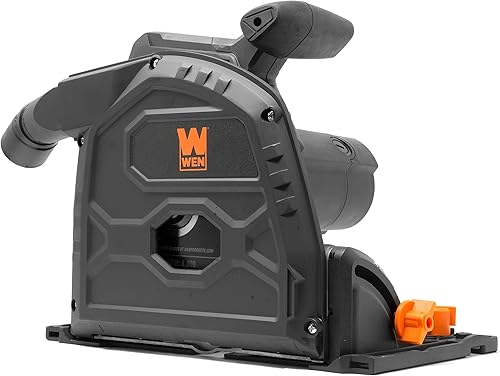
WEN CT1274 Track Saw: Best for thicker board projects
- 7-1/4 in blade format
- Variable speed operation
- 2.6 in rip capacity
- Swiveling dust port adapter
The deeper cutting capacity suits projects that exceed the reach of smaller alternatives. It accepts standard-size blades with 5/8 in arbors, subject to the saw's blade requirements.
Pros
- Deeper rip and bevel capacities
- Standard 7-1/4 in blade format
- 360-degree dust port adapter
Cons
- Compatible track and clamps sold separately
The WEN CT1274 is worth considering when thicker boards or deeper bevels rule out smaller-capacity options. It offers 2.6 in rip capacity and 1.85 in capacity at 45 degrees, with variable speed operation.
Its 7-1/4 in blade format uses a 5/8 in arbor, which gives you a familiar size to shop for. Still check blade type, kerf and speed requirements against the saw's instructions before fitting a replacement.
The swiveling dust port adapter helps you route the hose around the work area. That matters on long cuts, where a hose pulling sideways can interfere with your feed.
Choose this saw if its extra depth answers a real project need. Skip it if you mainly cut thin sheet goods and would choose it only because a larger blade sounds more capable.
It works with WEN CT9502 and CT9110 tracks and CT992F clamps, sold separately. Confirm usable depth with your intended rail, especially when the material approaches the saw's capacity.
DeWalt DWS520K Track Saw Kit: Best for DeWalt rail users
- 12 A corded motor
- Dual-edged track compatibility
- Track-aware depth scale
- Riving knife and anti-kickback mechanism
A natural fit for buyers building around DeWalt's dual-edged track system. Its depth scale accounts for the rail, and the kit includes the saw, finishing blade, wrench and case.
Pros
- Dual-edged track compatibility
- Riving knife and anti-kickback mechanism
- Depth scale accounts for track thickness
Cons
- Compatible rail must be planned separately
The DeWalt DWS520K makes sense for buyers who want to build around DeWalt's dual-edged tracks. Those tracks provide a cutting edge on either side, allowing more choices when positioning the rail on a workpiece.
Its depth scale accounts for track thickness. That removes one source of confusion when setting the blade to pass through the work without cutting too deeply into the support below.
A riving knife and continuous anti-kickback mechanism help address blade pinching and unwanted movement when used correctly. They don't replace full work support, proper feed direction or the procedures in the manual.
The kit includes a finishing blade, wrench and case with the saw. Plan the compatible rail separately rather than assuming the word “kit” means every guided-cut accessory is included.
Buy it if you value this rail system and its depth-setting approach. Skip it if you're already equipped with another rail platform unless you've confirmed that changing systems makes sense for your work.
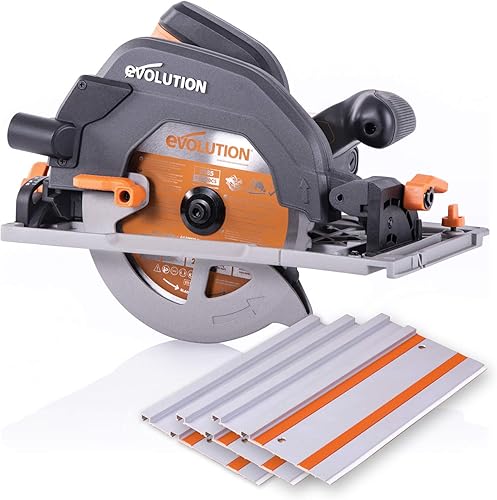
Evolution R185CCSX Track Saw Kit: Best for mixed-material repairs
- 15 A corded motor
- 40 in track included
- Multi-material blade included
- Dust extraction port and adapter
The included rail and multi-material blade suit shorter repair cuts across approved wood, plastic and metal applications. The supplied track is too short for full-sheet lengthwise cuts.
Pros
- Track included
- Designed for several material types
- Dust extraction adapter included
Cons
- Short supplied rail limits guided cut length
- Circular saw format rather than a dedicated plunge model
The Evolution R185CCSX suits shorter repair jobs involving approved wood, plastic and metal applications. It includes a multi-material blade and a 40 in track, giving it a different role from a wood-focused plunge setup.
The included rail is useful only when it has enough length to guide the saw through the whole cut. Its overall length is not the same as usable cutting travel because the saw needs support at both ends.
This is a circular saw and track kit, so don't choose it for interior starts that require a dedicated plunge mechanism. Check how you will enter and finish each cut before buying.
Choose it for mixed-material repair work where the supplied rail fits your projects. Skip it if your main goal is sizing full sheets or making controlled internal plunge cuts.
Follow the material-specific instructions for blade use, workholding and debris handling. A dust port doesn't make ordinary woodworking extraction equipment suitable for every material the saw can cut.
Milwaukee M18 FUEL Plunge Track Saw: Best for M18 remodelers
- 18V battery power
- Brushless motor
- Adjustable rail-fit cams
- Micro-adjust depth knob
This bare tool fits remodelers already equipped with compatible M18 batteries and charging gear. Rail-fit adjustment and fine depth control help with careful setup for panel and plunge cuts.
Pros
- Adjustable saw-to-rail fit
- Riving knife
- Vacuum port and dust bag
Cons
- Battery setup and compatible rail required separately
The Milwaukee M18 FUEL Plunge Track Saw is the clearest fit for remodelers already equipped with compatible M18 batteries and a charger. As a bare tool, it needs that power setup and a compatible rail before guided work can begin.
Its adjustable cams let you set the saw-to-rail fit, while the micro-adjust depth knob supports small depth changes. These controls matter when you want the saw to move freely without side play.
The riving knife helps keep closing material from pinching the blade. A vacuum port and dust bag address dust collection, and the port accepts 1-7/8 in vacuum hoses.
Choose it if staying within your M18 system simplifies your working day. Skip it if you have no M18 equipment and would rather start with batteries and charging gear already bundled.
Set the rail fit with the saw disconnected from power, following the manual. Excess cam pressure can make travel stiff, so aim for controlled movement rather than the tightest possible fit.
WEN Cordless Track Saw: Best for outlet-free DIY projects
- Two 20V Max 4.0Ah batteries included
- Brushless motor
- Variable speed operation
- Compatible WEN track sold separately
An option for DIY buyers who want cordless operation with batteries and charging gear included. Add a compatible WEN rail and confirm on-track depth for thicker work.
Pros
- Two batteries and charger included
- Track-alignment cam
- 48-tooth carbide-tipped blade included
Cons
- Compatible track not included
- Thicker cuts require careful capacity checks
The WEN Cordless Track Saw suits DIY buyers who want to work away from outlets and need batteries included. It comes with two 4.0Ah batteries and a charger, plus a 48-tooth carbide-tipped blade.
Both battery ports supply the saw, so the included pair is its operating set. Plan charging around your work rather than assuming one included battery can stay on charge while the other runs the saw.
The track-alignment cam lets you adjust rail fit, and the dust port adapter supports extraction. Compatible CT9502 or CT9110 tracks and CT992F clamps are separate.
Choose it for cordless shelving, door trimming and panel projects without an existing battery platform to build around. Skip it if you already own suitable Makita or Milwaukee equipment and prefer to share batteries across tools.
For thicker stock, confirm usable straight-cut depth with the rail you intend to use. For ordinary sheet goods, spend equal attention on support, blade choice and rail placement rather than chasing maximum depth.
What should you check before buying a track saw?
Start with your longest cut, thickest material and power access. Those requirements narrow the field faster than comparing motor figures alone.
Which rail system fits the best track saw for you?
Choose a compatible rail long enough to guide the saw before blade entry and after blade exit. A rail that merely matches the panel's length may leave too little travel at either end.
Joined rails can make storage and transport easier, but the joint needs careful alignment. Check connector compatibility and straightness before trusting a joined setup on a finished panel.
Our guide to circular saw guides and guide rails explains the differences between guide systems. Don't assume a similar-looking rail fits another brand's base.
How much cutting depth do you actually need?
Use the thickest planned cut as your starting point, including bevels. Angling the blade reduces usable depth, and the rail can also affect the capacity available at the workpiece.
Most sheet-sizing jobs don't need the deepest saw in this group. Thick boards, doors and angled cuts deserve closer checks, especially if you expect one pass to finish the job.
Avoid buying at the exact capacity limit without confirming how the manufacturer measures depth. Allow for the actual stock thickness and your on-track setup.
Should you choose corded or cordless power?
Choose corded for a steady cutting station near an outlet, and cordless for frequent moves or awkward cord routes. A cordless saw connected to extraction still has a hose to manage.
Battery ownership should influence the choice, but only after you confirm compatibility and the required pack count. For longer sessions, include charging time and any spare packs in your plan.
The broader circular saw buying guide helps if you're still deciding which saw format belongs in your tool collection.
Which blade and dust accessories should you plan for?
Choose a blade approved for the saw and suited to the material and finish you need. A ripping blade, a fine-finish plywood blade and a multi-material blade serve different jobs.
Check diameter, arbor, kerf and speed limits together. A matching diameter alone doesn't mean a blade is suitable.
For extraction, check hose fit and reach before cutting. Keep the hose supported so its weight doesn't drag against the saw or shift the rail.
Is a dedicated track saw worth the setup?
A dedicated track saw earns its place when you regularly size panels or need controlled plunge cuts. A guided circular saw may be enough for occasional straight cuts.
Read our DIY track saw guide for the guide-based approach. Our circular saw vs track saw comparison explains the differences in cutting routines.
How do you set up a track saw for a clean first cut?
Begin with stable support, a correctly fitted rail and the right depth setting. Clean edges depend on the whole setup, so complete these steps before powering the saw.
Support the panel and the offcut
Use a flat cutting surface with sacrificial support beneath the blade path. Support both the keeper piece and the offcut so neither drops, twists or closes onto the blade.
Keep clamps, bench parts and hidden objects clear of the cut. A shallow blade setting still requires clearance below the work.
Prepare and align the rail
Follow the rail instructions for preparing a new splinter strip before using it as a cut reference. The trimmed edge helps show where that blade will cut.
Mark both ends of the cut, then place the rail so the kerf falls on the waste side. Clamp where needed, especially on slippery surfaces or awkward workpieces.
With power disconnected, check that the saw travels smoothly along the full rail. Route the cord and hose with enough slack to finish without pulling on the tool.
Set depth and make a scrap cut
Set depth according to the manual so the blade clears the material without unnecessary exposure below it. Confirm whether the depth scale already accounts for the rail.
Check a scrap piece for square, bevel angle and edge quality before cutting finished parts. If your saw provides a scoring setting, follow its specified sequence rather than improvising a shallow pass.
Feed steadily through the cut
Let the blade reach operating speed before entering the material, and maintain a steady forward feed. Pushing harder when the saw slows can worsen the cut and increase strain.
Keep your hands on the designated grips and clear of the blade path. For more on layout and support, read how to cut straight with a circular saw.
Which mistakes cause poor track saw cuts?
The common causes are rail movement, poor support and the wrong blade setup. Correct those before assuming the saw lacks power or accuracy.
- Measuring to the wrong side of the kerf: Decide which piece you're keeping before aligning the splinter strip.
- Treating a rail as a square: A track guides a straight line, but its position determines the angle of that line.
- Using a short rail beyond its reach: The saw needs guidance throughout blade entry and exit, not just across the middle.
- Forcing a dull blade: Stop and inspect a blade that burns, wanders or requires unusual feed pressure.
- Letting the offcut fall: A dropping piece can tear the final fibers or pinch the blade.
- Backing through a cut: Follow the manual's recovery procedure rather than pulling a running saw backward along the rail.
For internal cuts, remember that a round blade's path below the surface extends beyond the visible top cut. Follow the saw's plunge-cut guidance and finish corners with a suitable method when square openings matter.
How should you care for the saw and rails?
Keep the blade clean, the rail straight and the plunge action unobstructed. Disconnect the cord or remove the batteries before cleaning, adjustments or blade work.
Brush dust from the rail grooves and saw base so buildup doesn't change how the tool travels. Use the manufacturer's cleaning guidance for blade resin and avoid applying lubricants to rail surfaces without approval.
Inspect the splinter strip and grip surfaces for damage or contamination. Replace worn parts as directed rather than compensating by pressing harder on the saw.
Store rails supported and protected from bends, dents and impacts. Before the next project, inspect the blade and confirm that the guard, plunge return and any fitted riving knife move as instructed.
Which best track saw setup should you choose?
Choose the Makita SP6000J for regular corded panel work, or the WEN CT1065 for occasional projects where a straightforward plunge setup fits. Move to the WEN CT1274 when added cutting depth solves a specific need.
For cordless work, buy the Makita XPS01Z if you already have the required LXT equipment, or the XPS01PTJ kit if you need it included. Existing M18 users should consider the Milwaukee, while the battery-included WEN offers another starting point for outlet-free DIY work.
Choose the DeWalt when its rail system fits your plans, and the Evolution for shorter mixed-material jobs that suit its circular saw format. Your best track saw is the one whose rail, blade and power setup fit the cuts you actually make.
If those cuts are still occasional, our guide to whether a track saw is worth it can help you decide how much dedicated equipment you need.
Our top 3 picks at a glance
-
1
-
2
-
3
Frequently asked questions
What makes a track saw different from a circular saw?
A dedicated plunge track saw combines a rail-guided base with controlled blade entry, making long panel cuts and internal starts easier to plan; a circular saw can also follow a suitable guide, but its cutting action and adjustments differ. Our circular saw vs track saw comparison explains which approach fits your work.
Do track saws come with a guide rail?
Some include a rail, while others require one separately; the Evolution R185CCSX kit includes a 40 in track, while the WEN models here need compatible rails bought separately. Check the actual package contents, rail compatibility and usable cutting length before treating any kit as a complete setup.
Can a track saw replace a table saw?
A track saw can handle many panel-sizing jobs that otherwise go to a table saw, especially in a small shop; it moves across a supported sheet instead of requiring you to push the sheet across a machine. A table saw remains useful for repeated narrow rips and fence-based production work.
Is a cordless track saw worth choosing?
Cordless power makes sense when you move between work areas or cannot route an extension cord easily; existing batteries can make a bare tool practical, but check compatibility first. Starting from scratch favors a battery-included kit, although you still need a suitable rail, work support and any required dust extraction gear.
How long should a track be?
Choose a rail that supports and guides the saw before the blade enters the work and after it leaves; the rail therefore needs more length than the cut itself. Check the saw's required overhang, and use only compatible connectors if you plan to join shorter sections for larger panels.