What Size Circular Saw to Cut a 2x4?
For a square 90-degree cut across a flat 2x4, a 6-1/2 inch circular saw is enough. Choose a 7-1/4 inch saw when you want full depth through the 3-1/2 inch face, room for bevels, or a blade that cuts framing lumber in one pass.
On this page (6 sections)
A 2x4 is 1-1/2 inches thick and 3-1/2 inches wide, so the question of what size circular saw to cut 2x4 comes down to how deep the blade reaches. A 6-1/2 inch saw cuts a flat 2x4 in one pass, and a 7-1/4 inch saw covers every cut you'll make in framing lumber.
The size label on a circular saw is the blade diameter, not its cutting depth. That's why two saws one inch apart in size can behave very differently on the same board.
The table below shows what each common size reaches in real wood.
What size circular saw cuts through a 2x4?
The answer is 6-1/2 inches or larger for a flat cut, and 7-1/4 inches for a 2x4 stood on edge. A 2x4 laid flat presents its 1-1/2 inch thickness to the blade, so almost any circular saw gets through it.
Stand the same board upright and the blade has to cut 3-1/2 inches of wood.
Depth of cut at 90 degrees is what matters, and it runs a little under half the blade diameter. A 6-1/2 inch blade reaches roughly 2-1/8 inches, and a 7-1/4 inch blade reaches about 2-1/2 inches.
That's the figure saw makers publish, and it's the number to compare when you're sizing a saw for a 2x4.
The practical result is simple. For a flat 2x4, a 6-1/2 inch saw leaves a comfortable margin.
For an upright cut, 7-1/4 inch is the closest class, but it still leaves part of the upright 2x4 uncut and requires a second pass. The Makita 5007Mg lists a 2-1/2 inch capacity at 90 degrees, which matches the general figure for the class.
How deep each blade size actually reaches in a 2x4
Blade size is the outer diameter, and the saw's base plate sits between the blade and the wood. That geometry costs you depth, so a "7-1/4 inch" saw doesn't cut 7-1/4 inches deep.
The published depth figures are always well under the blade diameter.
| Blade size | Depth at 90 degrees | Depth at 45 degrees | Cuts a 2x4 flat? | Cuts a 2x4 upright? |
|---|---|---|---|---|
| 5-3/8 in | About 1-5/8 in | Under 1 in | Just, at 90 degrees | No |
| 6-1/2 in | About 2-1/8 in | About 1 in | Yes | No |
| 7-1/4 in | About 2-1/2 in | About 1-3/4 in | Yes | No, second pass |
| 8-1/4 in | About 2-3/4 in | About 2 in | Yes | Yes |
The 5-3/8 inch saws sold for light trim sit too close to the 1-1/2 inch thickness for comfort. A 6-1/2 inch saw is the smallest size that handles a 2x4 without you worrying about a slow feed rate or a blade binding.
The margin at that size is only about 5/8 inch over the board's thickness, so the blade has to be sharp and the shoe has to sit flat on the wood.
Pick 7-1/4 inch as your baseline for 2x4 work. It's the size most lumber yard and framing blades are made for.
That also explains why the two best sellers in the circular saw category, the DeWalt DCS391B at number one and the Skil 5280-01 at number two, split between the two classes.
When is a 6-1/2 inch circular saw enough?
A 6-1/2 inch saw is enough when every 2x4 cut stays flat and square, such as cutting studs to length on the ground or trimming decking boards. It's also the size that cordless saws tend to use, because a smaller blade draws less power from a battery.
The DeWalt DCS391B shows what that size looks like in a cordless tool. Its 6-1/2 inch blade spins at 5,150 rpm on a 20V battery, and the magnesium shoe keeps the base light and stable on the board.
DeWalt lists a 0 to 50 degree bevel range and a keyless blade change.
Cordless saws in this size suit framing tasks where you're moving around the job. You cut one board, set it, and cut the next without dragging a cord.
The catch is that a 6-1/2 inch blade won't plunge through a 2x4 stood upright or a beveled 2x4 in one pass.
If your cutting list is mostly flat stock, though, this size gives you the portability without a depth problem. That's the case where 6-1/2 inches earns its place.
DeWalt DCS391B: cordless size for flat 2x4 cuts
The DCS391B is the lightest option here in use, because there's no cord to manage. Its bevel range goes to 50 degrees, so you can cut an angled end on a 2x4 as long as the board is flat.
The shoe is magnesium, which DeWalt says is high strength and lightweight, and the grip is rubber over-molded for balance and control in the hand.
The 18-tooth blade in the data is a ripping style tooth count. It's built for fast cuts in wood rather than fine joinery.
Plan on a cleaner blade if you want square, splinter-free ends on visible lumber.
Battery and charger are sold separately, so the tool is a bare unit. Budget for a battery platform if you don't already own DeWalt 20V packs.
That's the real cost of going cordless. DeWalt backs the tool with a 3 year limited warranty.
Choose this saw when your 2x4 cuts are flat, your work moves around, and you already own or plan to buy into the battery system. Skip it if upright cuts or steep bevels are regular jobs.
For a wider view of the cordless field, our best circular saws roundup covers the main contenders.
When do you need the extra reach of a 7-1/4 inch saw?
You need a 7-1/4 inch saw when you'll cut 2x4s stood on edge, bevel the ends, or cut double-thick lumber. The extra blade diameter buys about 3/8 inch more depth, and that still leaves part of the 3-1/2 inch face uncut, so a second pass or a larger blade is needed to clear it at 90 degrees.
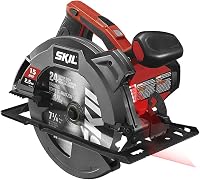
The Skil 5280-01 is a corded 7-1/4 inch saw with a 15-amp motor that turns the blade at 5,300 rpm. It includes a 24-tooth carbide blade and a spindle lock for easier changes.
A single-beam laser marks the cut line, and a dust blower keeps the line clear. The kit also includes a wrench and a carry bag, and the trigger is guarded with a safety lock and power-on indicator to reduce accidental starts.
The Makita 5007Mg takes the same size further. It uses magnesium components and weighs 10.6 lb, and its 15-amp motor spins at 5,800 rpm.
The cutting capacity is 2-1/2 inches at 90 degrees, with a bevel range to 56 degrees and positive stops at 22.5 and 45 degrees. Two LED lights light the cut line, and the kit includes a 24-tooth blade, a case, a hex wrench and a rip fence.
Both saws handle flat cuts fully; upright cuts need a second pass. The Makita's 2-1/2 inch depth and positive bevel stops make it the more precise choice for repeated angled cuts.
The Skil's laser guide helps when you're cutting to a marked pencil line rather than a stop. Makita backs its saw with a 1 year warranty, against the Skil's kit contents and DeWalt's 3 year limited warranty, so read the terms before you buy.
Skil 5280-01 and Makita 5007Mg: the 7-1/4 inch class
The Skil suits buyers who want a corded saw for general carpentry at a modest price tier. It's a full-size 7-1/4 inch saw with the standard 15-amp power and a 24-tooth blade ready to cut lumber.
The 51 degree bevel with a 45 degree positive stop covers common framing and trim angles. Its stated compatible materials are engineered wood and wood, which covers the lumber you'll meet on a 2x4 job.
The Makita is the stronger pick for framing work. The 2-1/2 inch depth at 90 degrees and the 56 degree bevel range mean upright cuts and steep bevels stay within its reach.
Magnesium construction keeps the weight reasonable for a saw this size, and the rip fence makes it easier to cut straight along a board's edge. Makita's own description lists framing walls, floors and roofs, plus ripping panels such as plywood and OSB.
Corded saws in this class don't need batteries, so the tool is always ready. The trade-off is a cord to route and a heavier body to carry.
Both saws are heavier than the 6-1/2 inch cordless option, so the extra reach costs you portability.
Pick the Skil for a first full-size saw on general jobs, and pick the Makita when depth and bevel accuracy matter most. Both handle flat cuts fully; upright cuts need a second pass.
Our guide to cutting straight with a circular saw covers the guide and technique that keep these longer blades on line.
How does a 2x4 cut upright, and when should you do it?
Cutting a 2x4 upright means standing it on its 3-1/2 inch edge and cutting down through the face. It's how you shorten an installed stud or trim a board in place.
Only an 8-1/4 inch or larger blade clears an upright 2x4 in one pass, while a 7-1/4 inch saw needs a second pass.
The upright position puts the full 3-1/2 inch width under the blade. A 6-1/2 inch saw with about 2-1/8 inches of depth leaves more than an inch of wood uncut.
You'd have to flip the board and cut from the other side, which is slower and risks a mismatched line.
Upright cuts also matter when a board is already fixed in place. A wall stud or a deck rim joist can't always be laid flat, so the saw has to do the work in the board's mounted position.
That's where the bigger blade pays for itself.
For beveled cuts the depth loss is steeper. A 45 degree bevel on a 2x4's face needs depth close to the full width, and only the 8-1/4 inch class has room for that in one pass.
Plan two passes or a different tool if a deep bevel is routine. Both 7-1/4 inch saws here carry positive stops that make repeated 45 degree cuts easier to repeat.
Choose 7-1/4 inches as the minimum when upright cuts are on your list. It's the smallest size that clears the face.
Bevels and double-thick stock push you up a size
An 8-1/4 inch saw reaches about 2-3/4 inches at 90 degrees and about 2 inches at 45 degrees. That's more headroom for thick or beveled stock, though it's a heavier saw to swing.
No saw in this comparison is an 8-1/4 inch model, so if your list includes a lot of deep bevels, look at that class on its own.
Double-thick 2x4s, often two boards nailed together for a header or post, present up to 3 inches of wood. A 7-1/4 inch saw's 2-1/2 inch depth falls just short there, so an 8-1/4 inch blade or a two-pass cut is the practical answer.
The Makita's 2-1/2 inch capacity confirms how close the standard size gets without quite covering it.
The right size follows the cut list. Write down each cut you'll make in the next month and note whether the board sits flat, upright or beveled.
The largest cut sets your minimum blade size. If the deepest cut is a flat 2x4, a 6-1/2 inch saw fits the job; if it's an upright or a bevel, move up.
Does blade tooth count matter as much as blade size?
Tooth count matters for cut quality and speed, but blade size decides whether the saw reaches through the wood. Get the size right first, then choose a blade for the finish you want.
A 24-tooth carbide blade is the usual general-purpose choice for framing lumber. It cuts fast, and both the Skil and Makita kits ship with 24-tooth blades.
Fewer teeth means a faster, rougher cut; more teeth means a slower, cleaner one. On a 2x4 you mostly want speed for framing and a decent edge for visible work.
The DeWalt lists an 18-tooth blade. That's a ripping-style count, suited to fast lengthwise cuts in solid wood.
It's not the blade you'd fit for clean crosscuts on finished trim. DeWalt also lists the blade material as high-speed steel and describes a carbide-tipped blade, so check the fitted blade before you buy.
Match the tooth count to the job after you've settled the size. A 24-tooth general blade covers most 2x4 work, and a finer blade handles visible cuts.
Both saws that ship with 24-tooth blades in this group are corded 7-1/4 inch models, which is part of why that size is the easy first buy for lumber work.
Corded or cordless at each size?
Corded saws suit a bench or a job where an outlet is close. The Skil and Makita are both corded 15-amp tools, so they run all day without a battery change.
Their larger 7-1/4 inch blades also need more motor than a battery pack typically supplies. The Makita's 15-amp motor turns at 5,800 rpm and the Skil's at 5,300 rpm, both faster than the cordless saw's 5,150 rpm.
Cordless saws suit moving around a site. The DeWalt's 6-1/2 inch blade matches the power a 20V pack can deliver.
That's why most cordless circular saws sit in the smaller size class. The DeWalt's 20V battery is not included, so the pack and charger are a separate purchase.
If your 2x4 cuts are flat and your work is spread out, cordless is the easier tool to live with. If you need full-depth upright cuts and long runs of cutting, the corded 7-1/4 inch saws are the practical choice.
The blade size and the power source tend to move together, so pick the size your cut list needs first and let that decide the cord.
Which size should you buy first?
Buy 7-1/4 inches as your first circular saw unless you're committed to a cordless platform and only cut flat stock. It's the size that covers the widest range of 2x4 jobs, from flat cuts to upright framing and bevels.
A 6-1/2 inch saw makes sense as a second, lighter tool or as part of a cordless kit you'll use for lighter work. It handles flat 2x4 cuts well and travels easily.
It just can't replace the bigger blade for full-face cuts. The DeWalt's 0 to 50 degree bevel and 5,150 rpm motor show how much a smaller cordless saw can do within its depth limit.
Buyers shopping for a 2x4 saw often end up choosing between blade reach and portability. The decision rule is short.
If the board will ever stand upright or be beveled, buy 7-1/4 inches. If every cut is flat and you value a light, cordless tool, 6-1/2 inches is the right size.
Compare the depth figure for each saw against the blade size on the label.
If you're also cutting other materials on the same job, our guide on whether a circular saw can cut metal explains blade swaps and limits. And when your cuts need more precision than a base plate offers, read circular saw vs track saw before you decide which tool belongs in your shop.
To sum up what size circular saw to cut 2x4: buy 7-1/4 inches for full coverage of flat, upright and beveled cuts, and buy 6-1/2 inches only when flat cuts and portability are all you need. Measure your deepest planned cut, compare it with the depth at 90 and 45 degrees, and let the larger cut set the size you buy.
Frequently asked questions
Is a 7-1/4 inch circular saw too big for cutting 2x4s?
No. A 7-1/4 inch saw cuts a flat 2x4 with room to spare and reaches about 2-1/2 inches deep, so flat cuts and bevels are no problem.
It still needs a second pass for upright cuts.
The trade-off is more weight and a larger blade to buy.
How deep does a 6-1/2 inch circular saw cut at 45 degrees?
A 45-degree bevel takes a big bite out of depth. A 6-1/2 inch saw that cuts about 2-1/8 inches at 90 degrees loses roughly an inch at 45 degrees, so it cannot cut a 2x4's full 3-1/2 inch face in one beveled pass.
What is the most common circular saw size for framing?
7-1/4 inch is the standard for framing and general construction. It cuts a 2x4 flat or upright, leaves room for bevels, and takes the 24-tooth carbide blades that lumber work relies on.
Do I need a bigger saw for cutting treated 2x4s?
No extra blade size is needed. Treated lumber is still a 2x4, so a 6-1/2 inch saw handles a flat cut and a 7-1/4 inch saw handles it upright.
A sharp carbide blade matters more than a larger size for treated wood.