Best Small Handheld Circular Saws: How to Choose
The best small handheld circular saw for most buyers is the DeWalt DCS571B, because its 4-1/2 in blade and bevel gear cut 2x material at 90 degrees while the tool stays light enough to run one-handed. Pick a 5-3/8 in 12V saw only if you mostly trim sheet goods and thin lumber.
On this page (11 sections)
- What does a small handheld circular saw do better than a full-size one?
- What blade size and cut depth do you need?
- Why does bevel range matter on a compact saw?
- How much does weight and handle design affect control?
- Which battery platform should the saw run on?
- What safety features are worth having on a small saw?
- How we compared these three saws
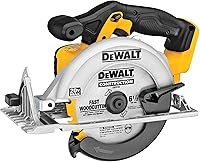
- DeWalt DCS571B 4-1/2 Inch Circular Saw: best overall
- DeWalt DCS512B 12V 5-3/8 Inch Circular Saw: best for light trim work
- Milwaukee M12 Fuel 5-3/8 Inch Circular Saw: best for M12 users
- Which small handheld circular saw should you buy?
The best small handheld circular saw for most buyers is the DeWalt DCS571B. Its 4-1/2 in blade and bevel gear cut 2x material at 90 degrees, and the saw stays compact enough to control with one hand.
Small saws make sense for plywood, trim, fencing and light framing rather than full sheets of thick stock. This guide works through blade size, depth, bevel range, weight and battery platform, then names three saws that fit different buyers.
If you are still weighing corded against battery power, read our cordless circular saw overview first.
What does a small handheld circular saw do better than a full-size one?
A small handheld circular saw wins on control and reach, not raw power. It fits one hand, gets into tight spots and is easier to carry up a ladder or across a roof.
A full-size 7-1/4 in saw is the better tool for cutting thick framing lumber all day. A small saw earns its place when the work is lighter and the space is tighter.
The trade is depth. A shorter blade cannot reach through the same thickness of material, so match the saw to your deepest planned cut before you buy.
A small saw that stays in a truck or tool bag gets used more than a heavy one you avoid carrying.
The main jobs that suit a small saw are sheet goods, trim, fencing, decking boards and light framing. Those tasks reward light weight and quick handling more than maximum cut depth.
For a wider look at the category and how the sizes compare, see our guide to the best cordless circular saws.
Pick a small saw when the deepest cut you make is 2x material or less and you value one-hand control. Pick a full-size saw when thick lumber and repeated deep cuts are routine.
What blade size and cut depth do you need?
Start with the deepest cut you make often, then choose the blade size that reaches it. Depth is set by blade size, and a smaller blade means a lighter saw but a shallower cut.
The two common small sizes are 4-1/2 in and 5-3/8 in. They behave differently in real work.
| Blade size | Typical use | Depth to plan for |
|---|---|---|
| 4-1/2 in | 2x material at 90 degrees, 1x at 45 degrees | Cuts 2x at 90 degrees on a bevel-gear saw |
| 5-3/8 in | Sheet goods, trim, decking boards | Up to 1-3/4 in at 90 degrees, 1-1/4 in at 45 degrees |
The DeWalt DCS571B uses a 4-1/2 in blade with a bevel gear design. That gearing lets a small blade cut 2x material at 90 degrees and 1x material at 45 degrees.
The DeWalt DCS512B uses a 5-3/8 in blade and reaches a maximum depth of 1-3/4 in at 90 degrees. At 45 degrees the maximum depth drops to 1-1/4 in.
The 5-3/8 in saw actually cuts deeper at 90 degrees, but it lacks the bevel-gear 2x advantage at 45 degrees that matters in framing. If 2x framing is a regular cut, the 4-1/2 in saw with a bevel gear is the safer choice.
Measure a scrap of your thickest material and compare it with the depth figures before you decide.
Choose the 4-1/2 in saw if you cut 2x at 90 degrees; choose a 5-3/8 in saw if your work stays in sheet goods and thin boards.
Why does bevel range matter on a compact saw?
A bevel lets the saw tilt for angled cuts, and the range decides which materials you can cut at an angle. A saw with no bevel only makes square cuts.
Look for the bevel range and how you adjust it. A tool-free lever saves time when you switch between square and angled cuts.
The DeWalt DCS571B bevels to 45 degrees. That range is enough to cut 1x dimensional lumber at an angle, which covers trim and simple framing work.
The DeWalt DCS512B goes further, adjusting from 0 to 50 degrees with a tool-free bevel lever. The extra 5 degrees helps on steeper trim angles.
Check the depth at your bevel angle too. A saw that cuts 1-3/4 in flat may only reach 1-1/4 in at 45 degrees, so deep angled cuts need a bigger blade or a different approach.
If angled cuts are rare, a 45 degree bevel is plenty. If you cut roof rafters or steep trim regularly, a wider range earns its keep.
Pick a 45 degree bevel for general trim and framing, and a 50 degree range only if steep angled cuts are part of your routine.
How much does weight and handle design affect control?
Weight matters more on a small saw than on a full-size one, because you often hold it one-handed. A light saw is easier to control along a cut line and less tiring overhead.
The DeWalt DCS571B weighs 6.5 lb without its battery. It includes a removable auxiliary handle for more control and a 1-1/2 in finger trigger that lets you choke up on the tool.
The DeWalt DCS512B is built for high maneuverability with a light and compact design, and its rafter hook lets you hang the saw when your hands are full.
The Milwaukee M12 Fuel weighs 5.8 lb. Its compact M12 body keeps the saw small enough to fit into tighter spots.
Handle design changes how the saw feels in use. A finger trigger near the front lets your hand sit close to the cut, and balance matters too, so hold one before you buy if you can.
The removable auxiliary handle on the DCS571B lets you take it off when a tighter grip helps. A compact body matters when you cut between joists or in a cabinet opening.
For buyers who want the lightest options, our roundup of the mini circular saw models is a useful next read.
Pick the lighter saw if you work overhead or in tight spots; pick the saw with a removable handle if you switch between one-hand and two-hand cuts.
Which battery platform should the saw run on?
Buy the saw for the batteries and chargers you already own. A small saw that needs a new platform costs more than the saw itself in the long run.
All three saws here are battery powered and sold as tool only, so you supply the battery and charger.
The DeWalt DCS571B runs on the 20V MAX platform. DeWalt says its brushless motor cuts up to 369 linear feet of 3/4 in OSB using a DCB205 battery, which is sold separately.
The DeWalt DCS512B runs on the 12V MAX platform and is part of DeWalt's XTREME Sub-Compact Series. Battery and charger are sold separately.
The Milwaukee M12 Fuel runs on the M12 platform and works with all M12 batteries and chargers. Its REDLINK PLUS intelligence manages communication between the tool, battery and charger and adds overload protection.
A 20V platform gives more power headroom for thicker cuts. A 12V platform keeps the saw smaller and lighter.
Check that the battery you plan to use fits the saw and the charger you own. If you already own Milwaukee M12 tools, the M12 Fuel saw makes sense.
If your shop runs on DeWalt 20V batteries, the DCS571B is the natural fit.
Buy the saw that matches a battery platform you already own, and only start a new platform when the saw itself is worth the extra cost.
What safety features are worth having on a small saw?
The safety features that matter most on a small saw are an electronic blade brake and stable handling. A brake stops the blade quickly after you release the trigger, which matters when the saw is light enough to set down fast.
The DeWalt DCS571B includes an electronic blade brake that stops the blade quickly for safety and productivity. That is a real advantage when you make many short cuts in a row.
Look for a trigger you can reach comfortably and a grip that stays secure with one hand. The 1-1/2 in finger trigger on the DCS571B lets you choke up on the tool for your application.
Dust control helps too. The DCS571B has an on-board dust port so you can connect a hose and keep the cut line clearer.
The DCS571B also keeps a blade key on board, so you are not hunting for a tool when a blade needs swapping.
The Milwaukee M12 Fuel adds overload protection through its REDLINK PLUS electronics. No saw removes the need for basic habits.
Support the material so it cannot pinch the blade and keep both hands clear of the cut line.
Pick the saw with an electronic brake if you make many short cuts; pick the one with a dust port if you work indoors and want a cleaner cut line.
How we compared these three saws
We compared these saws on the specs that change how a small saw feels and cuts. We looked at blade size, depth at 90 and 45 degrees, bevel range, weight, handle design and battery platform.
The score weighs those specs against what a buyer of a small handheld saw actually needs. Depth and control carry more weight than extras that do not affect the cut.
The DeWalt DCS571B scores 8.6 because it covers the widest range of small-saw jobs. It cuts 2x material at 90 degrees, bevels to 45 degrees and includes a brake and an auxiliary handle.
The DeWalt DCS512B scores 7.7. Its 5-3/8 in blade cuts 1-3/4 in at 90 degrees, which is deeper than the DCS571B's 1-1/2 in cut, but its 12V platform and lighter motor suit trim work better than repeated heavy cuts.
The Milwaukee M12 Fuel scores 7.6. Its brushless motor and REDLINK PLUS electronics are solid, but it needs the M12 platform and its depth is limited by its blade size.
A higher score means the saw covers more of the jobs a small saw is bought to do. Use the comparison table to check depth and bevel against your own work, then weigh the battery platform you already own.
| Product | Best for | Blade size | Power source | Weight | Our score |
|---|---|---|---|---|---|
| DeWalt DCS571B 4-1/2 Inch Circular Saw | overall | 4-1/2 in | Battery powered | 6.5 lb | 8.6 |
| DeWalt DCS512B 12V 5-3/8 Inch Circular Saw | light trim work | 5-3/8 in | Battery powered | 2.8 kg | 7.7 |
| Milwaukee M12 Fuel 5-3/8 Inch Circular Saw | M12 users | 5-3/8 in | Battery powered | 5.8 lb | 7.6 |
Treat the score as a fit guide for small-saw jobs, not a power ranking. A saw that matches your battery platform can serve you better than a higher-scored one that starts a new system.
DeWalt DCS571B 4-1/2 Inch Circular Saw: best overall
The DeWalt DCS571B is the best small handheld circular saw for buyers who want one tool to cover trim and light framing. Its 4-1/2 in blade with a bevel gear cuts 2x material at 90 degrees, and the saw stays compact.
DeWalt DCS571B 4-1/2 Inch Circular Saw: Best overall

- 4-1/2 in blade
- Bevel gear cuts 2x at 90 degrees
- Removable auxiliary handle
A compact 20V saw that still cuts 2x lumber at 90 degrees and lets you bevel 45 degrees through 1x stock.
Pros
- Cuts 2x material with a 4-1/2 in blade
- Electronic blade brake
- On-board blade key storage
Cons
- Weighs 6.5 lb
- Battery and charger sold separately
The bevel gear is the key detail. It lets a small blade cut 2x material flat and 1x material at 45 degrees, so the saw covers more than its blade size suggests.
The removable auxiliary handle and 1-1/2 in finger trigger give you control options. The electronic blade brake adds safety, and on-board blade key storage keeps blade changes simple.
DeWalt says the brushless motor cuts up to 369 linear feet of 3/4 in OSB with a DCB205 battery. That figure gives you a sense of runtime on light sheet goods.
Choose it if 2x material and 45 degree bevels are part of your work. Its depth and brake make it the most capable of the three for general small-saw jobs.
DeWalt DCS512B 12V 5-3/8 Inch Circular Saw: best for light trim work
The DeWalt DCS512B suits buyers who cut trim, sheet goods and decking boards and want a light saw with a wide bevel range. Its tool-free bevel lever adjusts from 0 to 50 degrees.
DeWalt DCS512B 12V 5-3/8 Inch Circular Saw: Best for light trim work
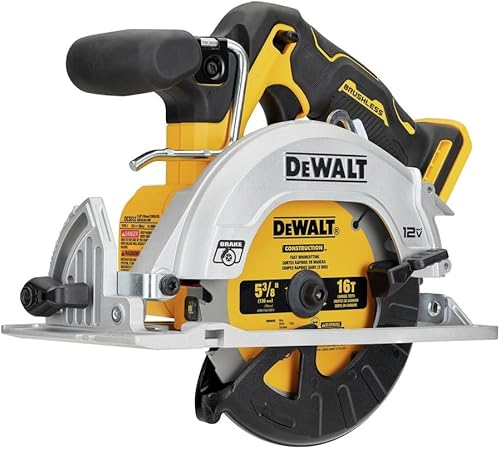
- 5-3/8 in blade
- 1-3/4 in cut at 90 degrees
- 0 to 50 degree bevel
A light 12V saw with a deep 1-3/4 in cut at 90 degrees and a tool-free bevel lever for quick angle changes.
Pros
- Light and compact design
- Tool-free bevel lever
- Built-in rafter hook
Cons
- Runs on the 12V MAX platform
- Battery and charger sold separately
Its 5-3/8 in blade reaches a maximum depth of 1-3/4 in at 90 degrees. That covers most trim and decking work without the weight of a bigger saw.
The 12V MAX platform and XTREME Sub-Compact design keep the saw light. A built-in rafter hook lets you hang it on the jobsite when your hands are full.
The tool-free bevel lever is the feature that stands out. You can switch from square to angled cuts without reaching for a wrench.
Its 12V platform and lighter motor make repeated 2x framing cuts a better fit for the DCS571B. Check the depth against your thickest material.
Choose it if you already own DeWalt 12V tools and your work stays in thin stock. The 50 degree bevel and light body suit trim and decking.
Milwaukee M12 Fuel 5-3/8 Inch Circular Saw: best for M12 users
The Milwaukee M12 Fuel suits buyers already on the M12 platform who want a compact saw with brushless power. Its POWERSTATE brushless motor and REDLINK PLUS electronics are the main draws.
Milwaukee M12 Fuel 5-3/8 Inch Circular Saw: Best for M12 users

- 5-3/8 in blade
- POWERSTATE brushless motor
- REDLINK PLUS intelligence
A 5-3/8 in M12 saw for buyers already on the Milwaukee 12V platform who want brushless power in a small body.
Pros
- Brushless POWERSTATE motor
- Overload protection through REDLINK PLUS
- Works with all M12 batteries and chargers
Cons
- Needs a separate M12 battery platform
- Lighter motor than a 20V saw
The M12 Fuel works with all M12 batteries and chargers, so it slots into a system you may already own. Its 5-3/8 in blade keeps the saw small and light.
REDLINK PLUS intelligence manages communication between the tool, battery and charger. That setup adds overload protection during demanding cuts.
The saw weighs 5.8 lb, making it the lightest of the three. That matters if you cut overhead or in tight spots.
Its 12V platform and lighter motor make deep cuts in thick lumber a better fit for the DCS571B.
Choose it if you already own Milwaukee M12 batteries. Its brushless motor and overload protection make it a strong fit for light trim and sheet goods.
Which small handheld circular saw should you buy?
Buy the DeWalt DCS571B if you want one small saw for trim and light framing, because its bevel gear cuts 2x at 90 degrees and its brake and handle design give you control. Buy the DeWalt DCS512B if you own 12V DeWalt tools and cut thin stock.
Buy the Milwaukee M12 Fuel if your shop already runs on M12 batteries.
The deciding factors are your deepest regular cut and the battery platform you own. Measure your thickest material first, then check the depth figures at 90 and 45 degrees against that measurement.
Next, list the batteries and chargers you already own. A saw that matches them saves you a second platform.
If you are unsure how blade size and bevel affect the work you do, our how to choose a circular saw guide walks through the basics. For buyers who want the lightest saws in the category, our best mini and compact circular saws roundup covers more options.
And if you are still deciding between battery and corded power, the best cordless circular saws comparison is the place to start.
The best small handheld circular saw is the one that reaches your deepest cut and runs on your batteries. Start with the DCS571B for most buyers, then adjust for platform and depth.
Measure your material and your battery stock, then pick the saw that fits both.
Frequently asked questions
What is a small handheld circular saw good for?
A small handheld circular saw handles sheet goods, trim, plywood, fencing and light framing where a full-size 7-1/4 in saw is more weight than you need. Its shorter blade trades some cut depth for one-hand control in tight spots.
How deep can a small circular saw cut?
Depth depends on blade size. A 4-1/2 in blade set up with a bevel gear can cut 2x material at 90 degrees, while a 5-3/8 in blade reaches 1-3/4 in at 90 degrees and 1-1/4 in at 45 degrees.
Do small circular saws use the same batteries as full-size ones?
Often yes within the same brand line. The DeWalt DCS571B runs on the 20V MAX platform, while the DeWalt DCS512B and Milwaukee M12 Fuel use 12V systems.
Match the saw to batteries and chargers you already own to avoid buying a second platform.
Can a small circular saw bevel?
Many can. The DeWalt DCS571B bevels to 45 degrees for cutting 1x dimensional lumber, and the DeWalt DCS512B adjusts from 0 to 50 degrees with a tool-free lever.
Check the bevel range before you plan angled cuts.
Is a 12V circular saw powerful enough for decking?
It depends on the cut and the blade. A 12V saw with a 5-3/8 in blade reaches 1-3/4 in at 90 degrees, so it handles deck boards and thin stock well, but repeated deep cuts in thick lumber are a better fit for a 20V saw like the DCS571B.